Laura Downing a forensic auditor and election investigator penned the letter below to the RNC to share her concerns about election integrity in South Carolina and the nation. Here are some of her salient points:
All states need to ensure that no ineligible voters especially illegal immigrants are registered to vote. How can we be assured that our rolls are clean?
Transparency must be increased by providing key data and reports to citizens and inexpensive voter rolls as well as the ability for poll observers to have full access to all stages of the eleciton process. For example, currently observers aren’t even allowed to view the ballots during the hand-count audits so how can they confirm that the count is correct if it is not done publically like our constituion calls for.
Third party vendors should be eliminated where possible as they aren’t subject to citizen FOIA (Freedom of Information Act) requests.
Ideally electronic voting should be replaced with handmarked, handcounted paper ballots.
Why can’t our state allow access to records to help enhance confidence?
According to Rasmussen, approximately 66% of likely voters don’t trust our electronic voting systems. Could this be the reason for our state’s abysmal turnout in the primary of roughly 13%?
This should concern every election official and legislator. Instead, they excoriate those who question the elections and who request information to confirm the validity of the election process. To wit, our own SC Election Commission is still trying to sue SC Safe Elections, our grassroots group, for daring to ask for information about the 2020 election (namely Cast Vote Records). They won’t give up on their counterclaim that basically wants to prevent us from obtaining, via the South Carolina Freedom of Information Act, ANY information from the 2020 election as well as pay thousands of dollars of their legal costs. This is harassment in the form of overzealous lawyers spending our tax dollars to punish citizens for requesting records that help us validate our elections. We certainly hope that Judge Coble sees this for what it is and either dismisses (again) their counterclaim; or better yet, awards us our legal fees and admonishes the otehr side for their brute force tactics.
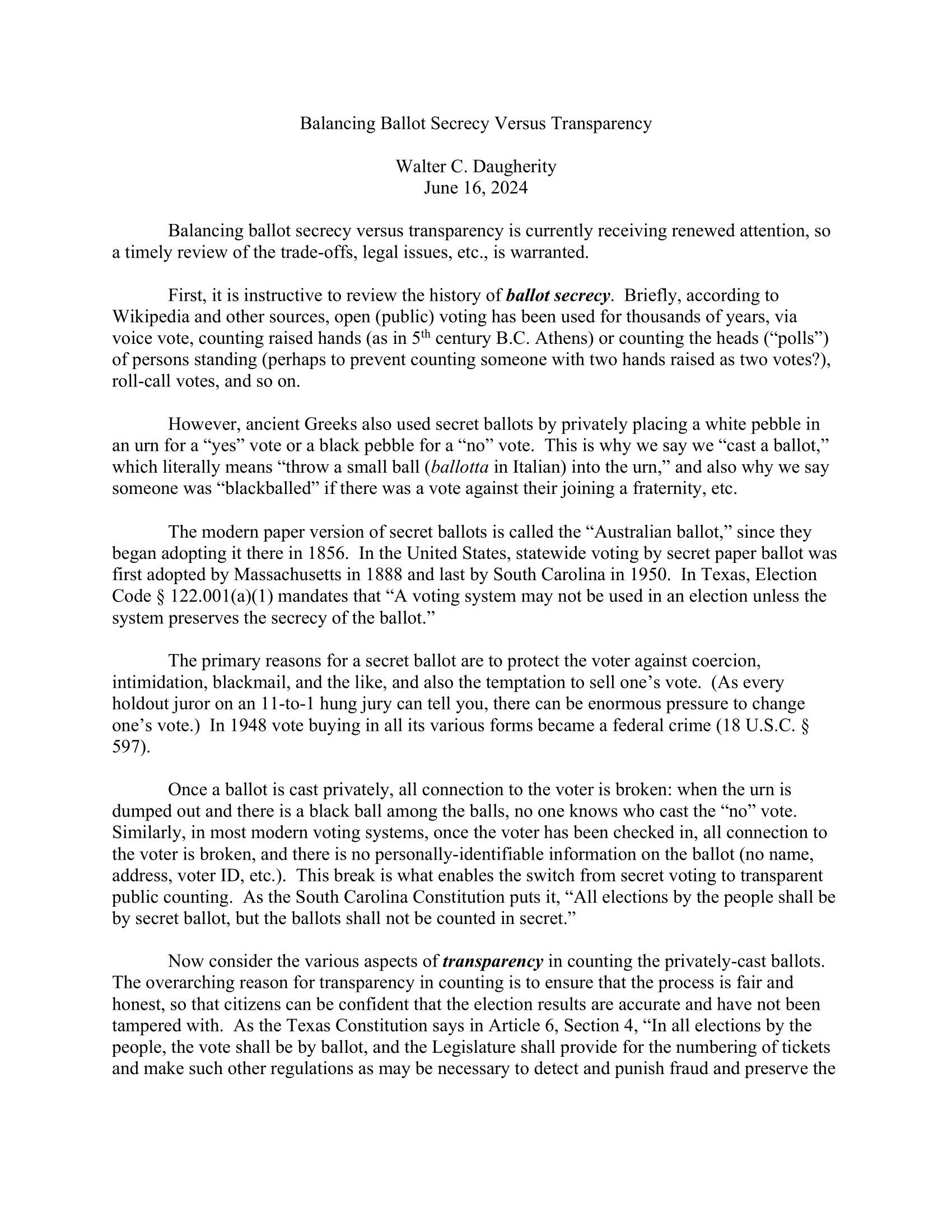
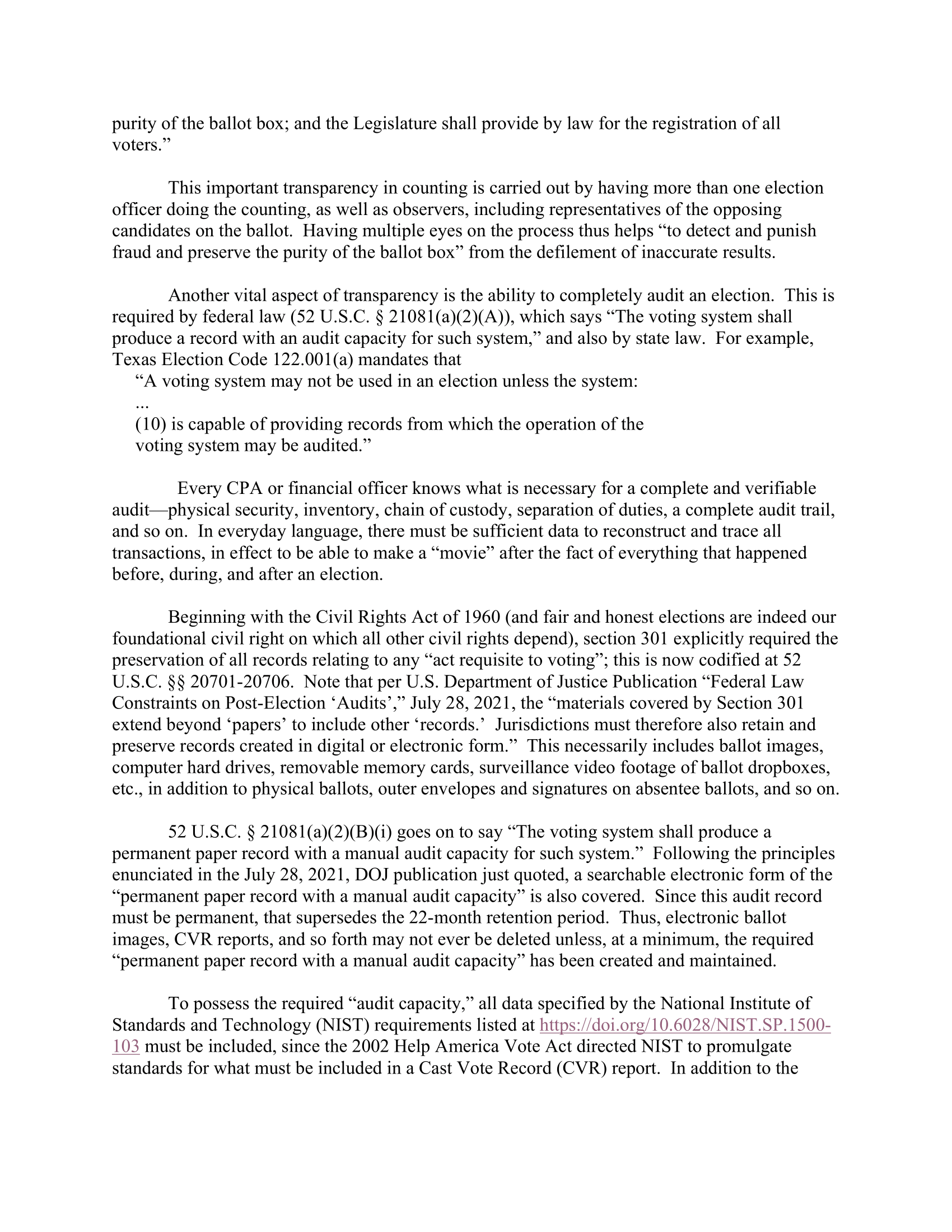
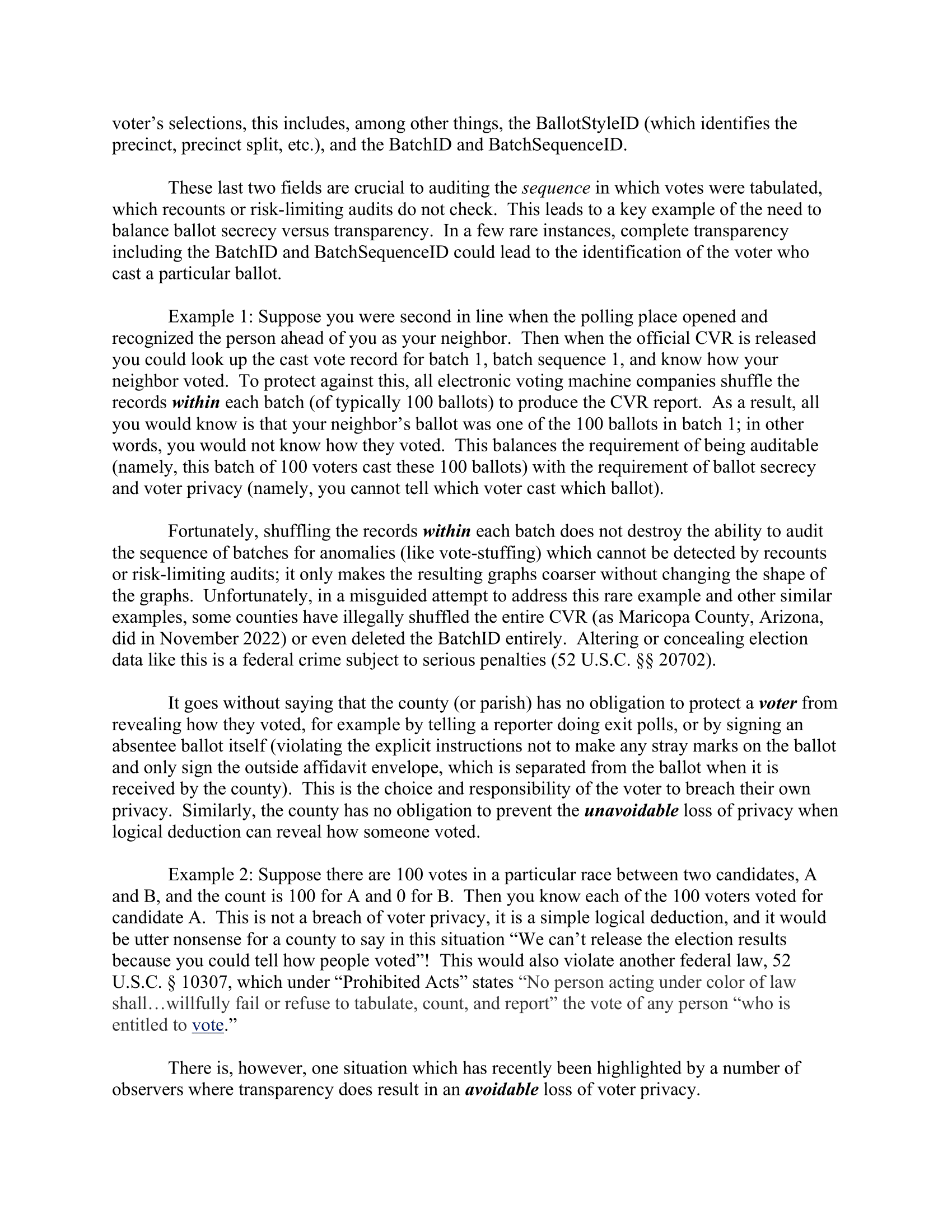
Dr. Daugherity, one of our expert witnesses, wrote an excellent article, “Balancing Ballot Secrecy Versus Transparency”, that succinctly underscores the importance of Cast Vote Records. In this must-read article, he provides the history of the secret ballot and emphasizes the importance of voter transparency. It is essential that states not only comply with our federal and state laws but that they also provide access to these records to ensure increased confidence in our election results.
He states:
“Every CPA or financial officer knows what is necessary for a complete and verifiable audit—physical security, inventory, chain of custody, separation of duties, a complete audit trail, and so on. In everyday language, there must be sufficient data to reconstruct and trace all transactions, in effect to be able to make a “movie” after the fact of everything that happened before, during, and after an election.”
When our election officials ask us to trust the system but don’t provide key reports and records it only foments distrust and suspicion. See the article below:
Several lawsuits are heating up and new ones being filed that underscore multiple issues in the Pennsylvania 2020 election. In particular, we are finding out that the state didn’t properly investigate compelling evidence of fraud.
In this must-see interview (start around 23 minutes) Greg Strenstrom and Leah Hoopes discuss their multiple suits and the shocking evidence that demonstrates how Bill Barr told the PA officials to stand down and not look into the 2020 election anomalies and evidence of potential fraud.
A new suit was filed by United Sovereign Americans, Inc., a nonpartisan, all-volunteer election validity advocate group, and two Pennsylvania residents directed to the Secretary of the Commonwealth, the Bureau of Elections, the Bureau of Election Security and Technology, the Department of State, and the state Attorney General. They have also named Attorney General Merrick Garland and the United States Department of Justice as additional “Respondents.”
They claim that federal voting standards are not being followed.
Auditing is the key to verifiability of the machine vote, but can we even trust an electronic system?
Auditing is a key component of the election process and thus needs to be robust, observable, and trustworthy. Unfortunately, our state procedures don’t inspire confidence. As stated in many prior articles, South Carolina citizens aren’t able to gain access to ANY meaningful reports such as cast vote records and security logs. Hand count audits are often done with small samples that aren’t statistically representative of an entire race and aren’t random, nor is the process viewable by observers. This does not align with the spirit of our law.
How can someone observe the process and feel confident about the results when they aren’t allowed to view the ballot content or reports derived from them? The secrecy of the ballot is meant to be during the process of casting a vote. Once cast, the ballot, which has no personally identifiable information, should be able to be viewed in its entirety. The only way to audit our elections is to do a full hand-count of all races. We can do this in an efficient manner using our hand count method as outlined in our gold standard elections whitepaper pages 14-20. https://www.scsafeelections.org/the-gold-standard-for-elections/
Better yet, why are we even using the machines? If we utilize a full handcount to audit to check the accuracy of the machine tabulation than why not just return to hand-counting hand-marked paper ballots?
Here is a truth-telling video that “red pills” the masses from Scott Adams. He makes a great point!
How secure are these machines?
CISA, the Center for Infrastructure and Security Agency, has been hacked. Multiple government agencies have been hacked and recently the Federal Reserve was hacked. If this can happen, we can’t fully trust that the most important currency we have (which is our vote) to an insecure system. From the article,
Josh Jacobson, Director of Professional Services at HackerOne says the threats made by LockBit speak to the fact that “even our most integral governmental entities are not infallible to ransomware attacks.”
“If the Federal Reserve is impacted, that could have global implications. This is not a siloed infrastructure where a finite number of customers are impacted. The potential for residual impact definitely factors in, as well as long-term reputation and trust,” he said.
Wake up America, are your elections clean or are your leaders selected for you? Who owns these system manufacturers? Who is in charge of monitoring them? The people need to take back their elections. We have developed a gold standard method for doing so. Let’s join other Euorpean nations who have returned to one day of voting on paper ballots which are hand-counted.
Here the Gold Standard team discusses the second phase of the election process or voter validation. Why is it important? We discuss several disturbing examples where Epoll book numbers jump, voters are erased in the middle of early voting, dead people voting, and many more.
We also discuss why it is near impossible to delete illegals as well as people who have passed away, moved. What happens when the machines go down? When should provisional votes be used? Why don’t the states allocate more funding to ensure there are no illegals registered?
3:00-12:15 Poll Book reconciliation with paper voter rosters 14:55-15:43 Poll book numbers jumping in Dallas County 13:41- 14:54 Obstruction of citizens receiving records 16:00- 17:04 Problems with poll books 17:09-19:36 Lost or incorrect votes/duplicate voters in two states 19:37-21:12 Names erased from the early voting database 22:55-24:10 Was it a hack? 24:20- 25:30 Are names removed or re-classified? 25:34- 27:00 Mail forwarding to avoid taxes 28:08-30:44 Election misinformation/gaslighting 31:01-33:33 Ohio cleans up non-citizen voters? Not so fast 36:13-37:21 How can they detect non-citizens voting? 45:00 Solutions and fascinating stories
Here is the GP article on the poll pads jumping in number in Dallas
In this interview with our colleague from South Dakota, Rick Weible, Laura discusses the importance of Cast Vote Records and why they are required by law to ensure an auditable trail. More importantly, they discuss the absolute GOLD STANDARD for elections which is one day of voting on hand-marked, hand-counted paper ballots, why we can no longer trust the current electronic voting system, and what you can at least do now to help mitigate the issues involved in electronic voting.
Laura sits down with Lisa Bracewell and Patti Black from the Greenville area who experienced election issues with the Blue Ridge Rural Water Board election October 10, 23.
The machine broke and the ballots were counted in secret behind closed doors. This is a violation of the SC constitution Article II section 1.
They requested information about the election under the Freedom of Information Act and were denied. In order for trust in elections to be restored we need transparency as well as respect for the FOIA laws in South Carolina. There are far more states in our country who do a better job. This is a disgrace and needs to be taken care of.
Here is a copy of the summons that was filed for the case:
The Epoch times recently had an article on how the FOIA law is broken. We couldn’t agree more. They look at examples and cases primarily regarding national issues. This broken system is being experienced down to the local level. In August of 2022, the South Carolina Safe Elections group and Michael Funderburk (plaintiffs) filed a lawsuit against the SC Election Commission (SEC) and 8 county Boards of Elections in SC (Aiken, Beaufort, Charleston, Dorchester, Greenville, Lexington, Spartanburg, and York) as well as a Temporary Restraining Order (which was granted) to preserve all 2020 election data.
The defendants had denied Freedom of information Act (FOIA) requests for an important audit report called a Cast Vote Record (CVR). Prior to September 2020, our election offices provided these reports and they were even used to for analysis in national whitepapers. But in August of 2020, just prior to the 2020 election, the then executive director of our state election commission, Marci Andino, decided that due to the fact that the new machines produce ballot images, these reports should not be provided. Not to mention the fact that she changed the definition of a cast vote record in her request to include not only the actual CVR report but also the ballot image and the physical ballot. She asked Alan Wilson’s SC Attorney General’s (AG’s) office to provide an “opinion letter” responding to the facts she presented.
The AG’s office issued a letter that agreed with her, as they could only make their determination on the facts provided by her. This was despite the fact that 28 other states and the District of Columbia provide Cast Vote Records to their citizens. Some counties even provide them online so that they can be conveniently downloaded for review and analysis. Curiously, she also decided at that time to ask for guidance from the AG’s office on preventing citizens from accessing security reports and the AG’s office also complied with that request. Reminder– many states allow public access to all of the aforementioned reports!
Why the sudden change and why just prior to the 2020 election? Also, why would the supposedly conservative state of South Carolina withhold valuable information from citizens who desire clarity and transparency in their elections?
UPDATE: The judge dismissed the case after a year and a half of “lawfare” and the case being designated “complicated,” our ability to present the facts has been denied. Note that our state FOIA law which is laid out in Title 30 is clear that FOIA lawsuits are ideally meant to be heard and concluded within 6 months. This is a travesty of justice and a total lack of respect for our state Freedom of Information Act.
This delay cost regular citizens copious legal fees (Around $100K) and frustration (note that the defendants also countersued us for a FOIA request) as well as the inability to properly analyze not only the 2020 election data but the 2022 midterm data as well. This should never happen. In a free society, transparency is the government’s obligation to share information with citizens. It is at the heart of how citizens hold their public officials accountable. If our government tries to withhold information from citizens, how can we trust it?
Now into the specifics of the case and our arguments. First, what is a CVR or cast vote record? From NIST (National Institute of Standards and Technology) manual Nov 2019 Publication 1500-103 Cast Vote Records Common Datra Format specification Version 1.0:
A CVR is an electronic record of a voter’s selections, with usually one CVR created per sheet (page) of a ballot (this is markedly different from Andino’s definition). Election results are produced by tabulating the collection of CVRs, and audits can be done by comparisons of the paper ballots or paper records of voter selections against the CVRs.
The NIST manual even states that these were meant for election officials and the public alike. Federal standards developed by NIST were done at the direction of the federal Election Assistance Commission (EAC).
There are many complex operations performed by voting devices when voters submit their paper ballots to be scanned. These operations are mostly invisible to voters but are necessary to determine whether contest selections have been marked adequately and whether voter intent is reflected by what is marked on the ballot. This specification includes the necessary detail to capture these operations so that CVRs can be better audited and adjudicated as necessary to include write-in candidates or other issues. This specification is geared towards the following audiences:
• Election officials • Voting equipment manufacturers • Election analysts and auditors • Election-affiliated organizations • The public
CVRs are an itemized receipt for our vote. Cast Vote records have been around since the mid-2000s yet the counties and the election commission claim to have no knowledge of these reports. The whole point of obtaining machines with physical ballots, ballot images, and a CVR database audit trail is to instill more public confidence in the process. If we can’t view the images or a record of how the vote was tallied for that election, how can we feel confident about our election results from our electronic voting system? Yes, we can review our ballot post-vote, but the tabulator machine isn’t reading our selections; it is scanning a barcode that is at the top of the ballot. How can we ensure that the barcode is not corrupted or that our vote changes once it is input into the machine?
Currently, we are only provided the final total vote count post-election, but we don’t receive the details for the vote. How was it counted over time? Were there any duplicate ballots? Was the adjudication done accurately? Due to the black box nature of our tabulators and the fact that we only receive the final total counts for our vote, we are currently counting our ballots in secret. This violates our state constitution.
The South Carolina Constitution states in Article II Section 1:
“All elections by the people shall be by secret ballot, but the ballots shall not be counted in secret. The right of suffrage, as regulated in this Constitution, shall be protected by laws regulating elections and prohibiting, under adequate penalties, all undue influence from power, bribery, tumult, or improper conduct.”
Secrecy of the ballot refers to the casting of the ballot. Once cast, the ballots should be counted or viewed in public. Andino’s memo to the AG’s office in August of 2020, which asks for their opinion, states that the ballots are “cast” when inserted into the tabulators. Marci Andino, herself, in old poll worker manuals, states that the counting should be public per the federal and state constitutions. How can we count the ballots if the machine is tabulating in secret, and then we only receive the end result? Her memo states that Title 7 has reference to the public’s right to observe processes associated with the counting of ballots, but then makes the leap that this suggests that the legislature did not intend for voted ballots to be subject to public disclosure! This is counter to exactly what has been stated in our poll managers’ handbooks for years. Also, our federal and state regulations and laws mandate that there is no identifying information on the ballots themselves. Ken Paxton, Texas Attorney General, as well as former Secretary of State of Arizona Ken Bennett, are on record as saying these records and images should be available to the public. Most of these states have ES&S systems like ours, so why does South Carolina view this issue differently? In addition, our federal and state laws call for a voting system with an audit capacity. Dr Daugherity, another one of our experts, cites this law in his affidavit.
“The statewide voting system currently used in the State has the necessary audit capacity,” namely, that “The voting system shall produce a record with an audit capacity for such system.” The CVR report is such a record.
“The voting system shall produce a permanent paper record with a manual audit capacity for such system” and “The statewide voting system currently used in the State produces an image of each vote cast; however, these votes cannot be associated with any particular voter.” Thus, disclosure of these images cannot compromise voter privacy, and neither can the ballots from which these images were produced, nor can the CVR produced from the ballots and/or ballot images
Here are the facts that the plaintiffs have that dispute the election commission and the counties’ weak arguments:
Argument 1- There is Personally Identifiable Information (PII) on the ballots; i.e. an individual’s ballots could be identified.
Counterargument- During depositions and discovery, the defendants admitted that there is no PII on the ballots, and our experts claim the same and that there is no way to tie a voter to a ballot. Other than the voter’s selections, the only information on the ballot about the voter is their precinct and their ballot style. One way that the SEC believes that a voter can be identified in terms of how they voted (and this is also very improbable if not impossible) is if there are just a few people with the same ballot style, and they all voted for the same candidate. There are roughly 950 persons who live in our entire state with less than 10 ballot styles, and these could be easily redacted or filtered from a CVR report. This is how other states handle this issue.
Furthermore, ES&S guarantees privacy in their own documents. In the Michigan Request for Proposal no. 007116B0007029 for Election Systems and Software on page 33 of 152, it states the following:
“Every ballot is assigned a random 16-byte identifier and all the ballot CVRs and Ballot images are stored on the inserted memory media with exactly the same timestamp. This effectively decouples any association of the ballot to the voting order to guarantee voter privacy.”
See Affidavit Rick Weible Supplemental Addendum below
Argument 2- They use the SC constitution ballot secrecy clause to keep us from seeing the ballots.
Counterargument: The ballots lack identifying information, and they overlook the issue of public counting, which is the second part of that clause. The casting of the vote is secret, not the counting. This is why safeguards are put into place to ensure that no identifying information is on any ballot. Note that if they believe that there is a way to tie ballots to voters to determine how they voted, we would need to abolish the current system entirely, since it doesn’t meet federal requirements that mandate secret ballots, AND that means that they (the SEC as well as ES&S) know how people voted.
Argument 3- The counties and election commission have limited knowledge of CVRs and have no way to “produce them” and shouldn’t have to, given that our state FOIA law states they don’t need to “create” data to provide to citizens. The defendants admit they didn’t retain or don’t have these records. This is a violation of federal laws: Reference 52 US Code 20701-2
Counterargument: This is concerning. These are important records required by federal and state law that have been around since the mid-2000s. They are essential to auditing elections, and they are also mentioned in their manuals and the system certificates in multiple places. It is their job to know about these reports and understand how to export/print them. Furthermore, they don’t need to create anything. The Cast Vote Records are created at the time of tabulation. In Boone County, MO, in their County Commission Meeting document dated 7/16/2019, it states:
Safeguards voter intent. The system captures and retains digital images and cast vote records of every scanned ballot for auditing and adjudication. ES&S does not alter a single digital image.
Again, see Affidavit Rick Weible Supplemental Addendum above
To further emphasize this point, one of our other experts Donnie Scroggins from Arkansas who gets CVR reports by request (Arkansas has the identical ES&S system to South Carolina) has videotaped how easy and quick it is to download a CVR report that has been uploaded via a flash drive into the Electionware system with just a few clicks of a button. Here is his video:
Argument: The Mickey Mouse defense- The Cast Vote Records could be used to promulgate fraud
Counterargument: This is the most ridiculous and inane claim. The defendants and Attorney General Alan Wilson argue that if a nefarious candidate or their proxy wanted to commit fraud, they could pay people to vote for them and use an alias as a write-in for another race to confirm their vote. So, for example, one would vote for Tom Smith for Treasurer and tell him that they will write in “Mickey Mouse” in another race to prove they voted for him. They are basically using this excuse of fraud, which they admit they never encountered, to disenfranchise citizens who are serious about checking for potential issues or fraud. Seriously? And by the way, the cast vote record reports can remove the “write-ins” with a click of a button, so this isn’t even an issue.
Argument: Small votes can be determined; for example, Provisional and UOCAVA
Counterargument:
Provisional votes – These are already potentially exposed due to the fact that if you have a few votes and someone attends the provisional hearings, they may be able to go to scvotes.gov and know how that person voted. If there is only 1 provisional in a precinct, and I attended the hearing and know who that person is, then the one provisional for that precinct will be disclosed by just looking at how the provisional voter voted in that precinct. Once again, this is a stretch as most people are not trying to determine how people vote in a provisional hearing. The CVR itself is not the pathway to determine votes, as that can be done just through the state’s reporting system.
Overseas votes/UOCAVA—These votes are already viewed by election staff as they come in via email and are then transcribed onto a ballot and then scanned. We are not sure how a CVR would expose a particular individual and how they voted, since the designation of who is UOCAVA isn’t disclosed anywhere.
Finally, Andino uses the 1939 Corn vs Blackwell case as a precedent for why the secrecy of the ballot is important but this has no bearing with our situation given that the ballots and the overall system is markedly and profoundly different from today’s system and the ballots don’t have sequential numbering on them nor can we determine order given the randomization and identical timestamps for each day that there is a tabulator in use; i.e. each cast vote record regardless of the time of the day will have an identical timestamp equivalent to the start of the machine, usually 7 AM in SC.
From Dr Daugherity’s expert affidavit:
This case is inapposite and irrelevant to the CVR report, since the CVR report contains no voter ID. voter registration number, ballot number, social security number, driver’s license number, name, address. birthdate. or any personally identifiable information whatsoever.
He further states:
AG Opinion’s conclusion that these public records … are not required to be disclosed is conditioned by the phrase “To the extent that the disclosure of materials related to a cast ballot would lead to the identification of a voter.” Since neither ballots, nor ballot images, nor CVR reports contain any personally-identifiable information whatsoever, the conclusion that they are not required to be disclosed fails.
Sorry but the judge got it WRONG!!! Here are additional expert affidavits which rebut the facts as presented in Marci Andino’s letter as well as the 2 AG opinions that were issued. The facts are on our side. This case should not have dragged out this long and this information should have been provided long ago. The people deserve to know how their vote was counted. Trust in the veracity of our elections is the cornerstone of our republic. Election integrity and FOIA law is not being respected and something must be done about it.
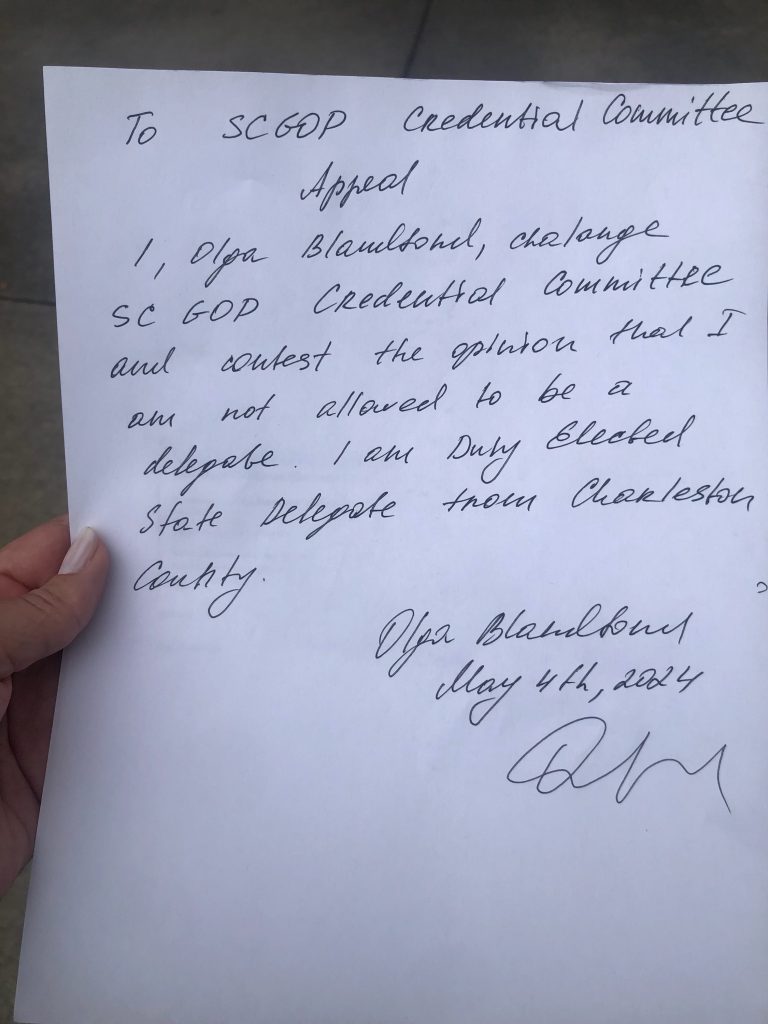
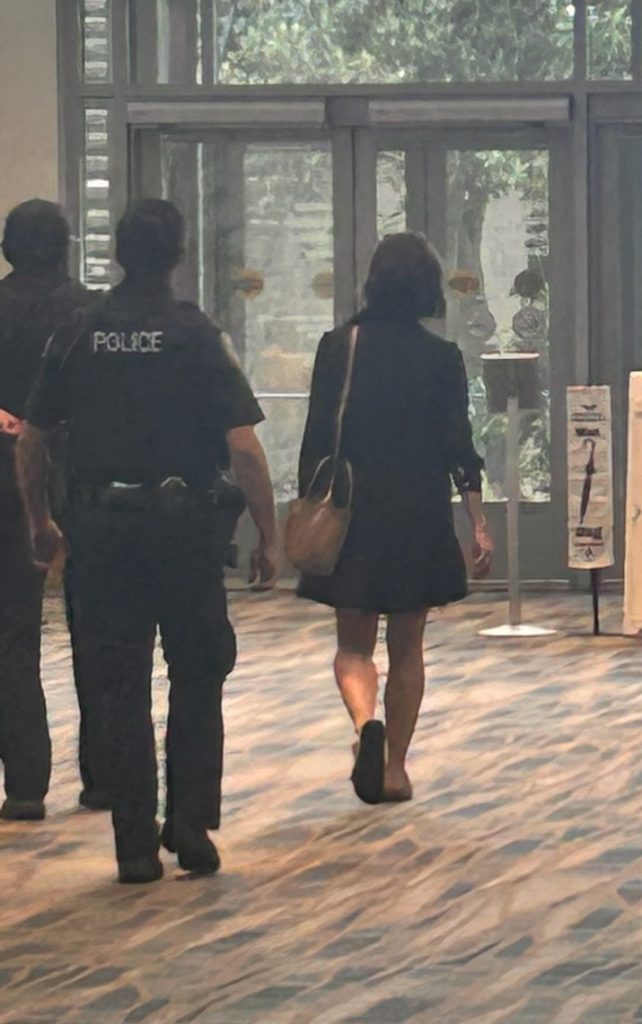
May 4th was the SC state convention and this video summarizes the lack of election integrity, transparency, respect, and unity experienced during the event. The convention president wouldn’t recognize people with points of order and Roberts Rules were not followed properly, several people were targeted and wrongly prevented from being delegates. They were ultimately escorted out of the event by the police. Furthermore, sneaky tactics were used such as mixing people from the American First national delegate ballot into the establishment ballot to make it look like it was the legitimate slate. Election interference comes in all forms.
Here is an intereview with the America First candidate for SC National Committeewoman, Cynthia Jones.
Here is a video of Olga Blandford being disallowed to vote and was escorted out of the building by police despite that fact that she had not violated the rules they claim she had. For more background on this story see https://rumble.com/v4snvhl-election-interference-at-the-local-level.html.
Another delegate being forced out of the building.
Here is a delegate asking for a standing hand count by county. They tired to shut him down and then had their way with the voice vote despite it seeming close if not favoring the ayes.
There has been a recent uproar regarding an X post by one of our legislators regarding voter registration forms that were provided to a refugee in Spartanburg. Before you get your panties in a bunch let us review our federal and state law.
The national voter registration also known as motor voter law allows for these forms to be made available in the state agencies.
The National Voter Registration Act of 1993 (also known as the “NVRA” or “motor voter law”) sets forth certain voter registration requirements with respect to elections for federal office. Section 5 of the NVRA requires that States offer voter registration opportunities at State motor vehicle agencies. Section 6 of the NVRA requires that States offer voter registration opportunities by mail-in application. Section 7 of the NVRA requires that States offer voter registration opportunities at certain State and local offices, including public assistance and disability offices. Section 8 of the NVRA contains requirements with respect to the administration of voter registration by States and requires States to implement procedures to maintain accurate and current voter registration lists.
What voter registration opportunity is required by Section 5 of the NVRA?
Each State motor vehicle driver’s license application (including any renewal application) submitted to a State motor vehicle authority must serve as a simultaneous voter registration application unless the applicant fails to sign the voter registration application. This application for voter registration must be considered as updating any previous voter registration by the applicant.
In addition, any change of address form submitted for State driver’s license purposes must also serve as notification of change of address for voter registration purposes unless the registrant states on the form that the change of address is not for voter registration purposes. This means that all changes of address submitted to State motor vehicle offices must be forwarded to election authorities unless the registrant affirmatively requests otherwise by opting out on the form.
Our state law also coordinates with this via Article 4 Section 7 5 310 and 7 5 320
These laws allow multiple state agencies to provide voter registration forms. Here is an excerpt from 7 5 310.
Multiple Site Voter Registration and Responsibilities of the State Election Commission in Implementing the National Voter Registration Act of 1993
SECTION 7 5 310. Definitions; designations.
(A) As used in this article:
(1) “Voter registration agency” means an office designated to perform specific voter registration activities;
(2) “Motor vehicle driver’s license” means any personal identification document issued by the Department of Motor Vehicles.
(B) There are designated the following voter registration agencies:
(1) Department of Social Services;
(2) Department of Health and Environmental Control WIC program;
(3) Department of Disabilities and Special Needs;
(4) Commission for the Blind;
(5) Department of Vocational Rehabilitation;
(6) South Carolina Protection and Advocacy System for the Handicapped;
(7) Armed Forces recruiting offices;
(8) Alcohol and Other Drug Abuse Services;
(9) Department of Mental Health.
(C) At each voter registration agency, the following services must be made available:
(1) distribution of voter registration application forms in accordance with subsection (F);
(2) assistance to applicants in completing voter registration application forms, unless the applicant refuses the assistance;
(3) acceptance of completed voter registration application forms for transmittal to the county board of voter registration and elections.
(D) If a voter registration agency designated under the provisions of this section provides services to a person with a disability at the person’s home, the agency shall provide the services described in subsection (C) at the person’s home.
(E) A person who provides services described in subsection (C) may not:
(1) seek to influence an applicant’s political preference;
(2) display a political preference or party allegiance;
(3) make any statement to an applicant or take any action, the purpose or effect of which is to discourage the applicant from registering to vote; or
(4) make any statement to an applicant or take any action, the purpose or effect of which is to lead the applicant to believe that a decision to register to vote has any bearing on the availability of services or benefits.
(F) A voter registration agency that is an office that provides service or assistance in addition to conducting voter registration shall:
(1) distribute to each applicant for the service or assistance, and with each recertification, renewal, or change of address form relating to the service or assistance the voter registration application form, including a statement that:
(a) specifies each eligibility requirement (including citizenship);
(b) contains an attestation that the applicant meets the requirement; and
(c) requires the signature of the applicant, under penalty of perjury; or
(2)(a) provide a form that includes:
(i) the question, “If you are not registered to vote where you live now, would you like to apply to register to vote here today?”;
(ii) if the agency provides public assistance, the statement, “Applying to register or declining to register to vote will not affect the amount of assistance that you will be provided by this agency.”;
(iii) boxes for the applicant to check to indicate whether the applicant would like to register or decline to register to vote (failure to check either box being considered to constitute a declination to register for purposes of subsection (G), together with the statement (in close proximity to the boxes and in prominent type), “IF YOU DO NOT CHECK EITHER BOX, YOU WILL BE CONSIDERED TO HAVE DECIDED NOT TO REGISTER TO VOTE AT THIS TIME.”
(2) If a registration application is accepted within five days before the last day for registration to vote in an election, the application must be transmitted to the county board of voter registration and elections not later than five days after the date of acceptance………..
Note the highlight above that specifically states that they are supposed to specify eligibility particularly citizenship.
What is illegal is for the noncitizen to register. If they vote in an election, it would be a felony and it would eliminate their ability to gain citizenship in the future.
The fundamental problem is that there is no formal identification to determine who is and who isn’t a noncitizen.
In fact, the only barrier to registering as a citizen is signing an oath to the effect that you are a citizen. See the “Voter Registration Oath” on the registration form below:
What we need are stronger ID laws (and border laws) and a definitive way to designate non citizenship on licenses, etc.
Note that the ease of these forms is not the issue it is the way we verify people. Anyone can download these forms and apply as well and if they are 65 or older no ID is required!
We need better controls and processes in our entire election system to fight dirty rolls and fraud. We also need our laws to be followed rigorously and there should be consequences if they are not. These two issues are the most fundamental to the problem. If law enforcement is not going to take this issue seriously, all the laws in the world won’t fix these problems. Accountability is key.