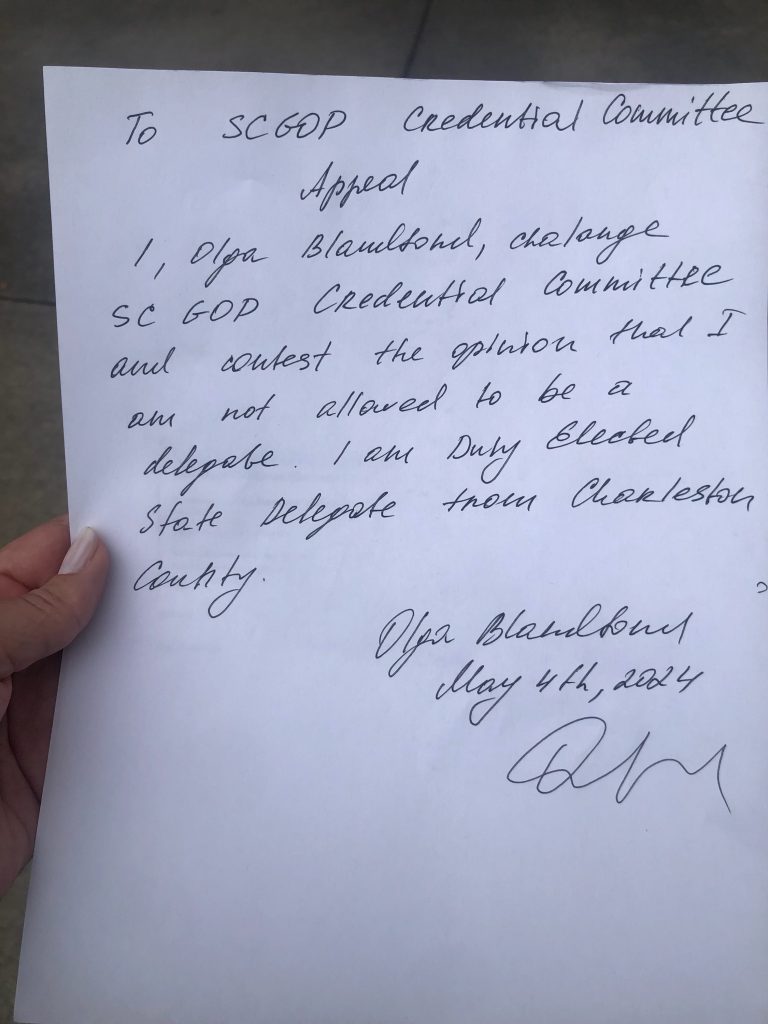
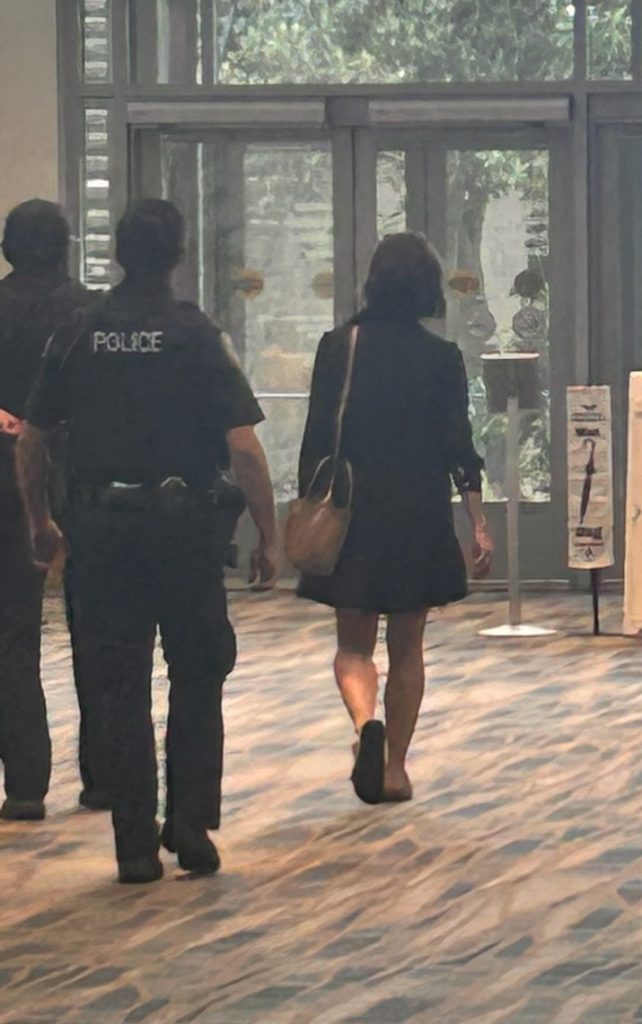
May 4th was the SC state convention and this video summarizes the lack of election integrity, transparency, respect, and unity experienced during the event. The convention president wouldn’t recognize people with points of order and Roberts Rules were not followed properly, several people were targeted and wrongly prevented from being delegates. They were ultimately escorted out of the event by the police. Furthermore, sneaky tactics were used such as mixing people from the American First national delegate ballot into the establishment ballot to make it look like it was the legitimate slate. Election interference comes in all forms.
Here is an intereview with the America First candidate for SC National Committeewoman, Cynthia Jones.
Here is a video of Olga Blandford being disallowed to vote and was escorted out of the building by police despite that fact that she had not violated the rules they claim she had. For more background on this story see https://rumble.com/v4snvhl-election-interference-at-the-local-level.html.
Another delegate being forced out of the building.
Here is a delegate asking for a standing hand count by county. They tired to shut him down and then had their way with the voice vote despite it seeming close if not favoring the ayes.
There has been a recent uproar regarding an X post by one of our legislators regarding voter registration forms that were provided to a refugee in Spartanburg. Before you get your panties in a bunch let us review our federal and state law.
The national voter registration also known as motor voter law allows for these forms to be made available in the state agencies.
The National Voter Registration Act of 1993 (also known as the “NVRA” or “motor voter law”) sets forth certain voter registration requirements with respect to elections for federal office. Section 5 of the NVRA requires that States offer voter registration opportunities at State motor vehicle agencies. Section 6 of the NVRA requires that States offer voter registration opportunities by mail-in application. Section 7 of the NVRA requires that States offer voter registration opportunities at certain State and local offices, including public assistance and disability offices. Section 8 of the NVRA contains requirements with respect to the administration of voter registration by States and requires States to implement procedures to maintain accurate and current voter registration lists.
What voter registration opportunity is required by Section 5 of the NVRA?
Each State motor vehicle driver’s license application (including any renewal application) submitted to a State motor vehicle authority must serve as a simultaneous voter registration application unless the applicant fails to sign the voter registration application. This application for voter registration must be considered as updating any previous voter registration by the applicant.
In addition, any change of address form submitted for State driver’s license purposes must also serve as notification of change of address for voter registration purposes unless the registrant states on the form that the change of address is not for voter registration purposes. This means that all changes of address submitted to State motor vehicle offices must be forwarded to election authorities unless the registrant affirmatively requests otherwise by opting out on the form.
Our state law also coordinates with this via Article 4 Section 7 5 310 and 7 5 320
These laws allow multiple state agencies to provide voter registration forms. Here is an excerpt from 7 5 310.
Multiple Site Voter Registration and Responsibilities of the State Election Commission in Implementing the National Voter Registration Act of 1993
SECTION 7 5 310. Definitions; designations.
(A) As used in this article:
(1) “Voter registration agency” means an office designated to perform specific voter registration activities;
(2) “Motor vehicle driver’s license” means any personal identification document issued by the Department of Motor Vehicles.
(B) There are designated the following voter registration agencies:
(1) Department of Social Services;
(2) Department of Health and Environmental Control WIC program;
(3) Department of Disabilities and Special Needs;
(4) Commission for the Blind;
(5) Department of Vocational Rehabilitation;
(6) South Carolina Protection and Advocacy System for the Handicapped;
(7) Armed Forces recruiting offices;
(8) Alcohol and Other Drug Abuse Services;
(9) Department of Mental Health.
(C) At each voter registration agency, the following services must be made available:
(1) distribution of voter registration application forms in accordance with subsection (F);
(2) assistance to applicants in completing voter registration application forms, unless the applicant refuses the assistance;
(3) acceptance of completed voter registration application forms for transmittal to the county board of voter registration and elections.
(D) If a voter registration agency designated under the provisions of this section provides services to a person with a disability at the person’s home, the agency shall provide the services described in subsection (C) at the person’s home.
(E) A person who provides services described in subsection (C) may not:
(1) seek to influence an applicant’s political preference;
(2) display a political preference or party allegiance;
(3) make any statement to an applicant or take any action, the purpose or effect of which is to discourage the applicant from registering to vote; or
(4) make any statement to an applicant or take any action, the purpose or effect of which is to lead the applicant to believe that a decision to register to vote has any bearing on the availability of services or benefits.
(F) A voter registration agency that is an office that provides service or assistance in addition to conducting voter registration shall:
(1) distribute to each applicant for the service or assistance, and with each recertification, renewal, or change of address form relating to the service or assistance the voter registration application form, including a statement that:
(a) specifies each eligibility requirement (including citizenship);
(b) contains an attestation that the applicant meets the requirement; and
(c) requires the signature of the applicant, under penalty of perjury; or
(2)(a) provide a form that includes:
(i) the question, “If you are not registered to vote where you live now, would you like to apply to register to vote here today?”;
(ii) if the agency provides public assistance, the statement, “Applying to register or declining to register to vote will not affect the amount of assistance that you will be provided by this agency.”;
(iii) boxes for the applicant to check to indicate whether the applicant would like to register or decline to register to vote (failure to check either box being considered to constitute a declination to register for purposes of subsection (G), together with the statement (in close proximity to the boxes and in prominent type), “IF YOU DO NOT CHECK EITHER BOX, YOU WILL BE CONSIDERED TO HAVE DECIDED NOT TO REGISTER TO VOTE AT THIS TIME.”
(2) If a registration application is accepted within five days before the last day for registration to vote in an election, the application must be transmitted to the county board of voter registration and elections not later than five days after the date of acceptance………..
Note the highlight above that specifically states that they are supposed to specify eligibility particularly citizenship.
What is illegal is for the noncitizen to register. If they vote in an election, it would be a felony and it would eliminate their ability to gain citizenship in the future.
The fundamental problem is that there is no formal identification to determine who is and who isn’t a noncitizen.
In fact, the only barrier to registering as a citizen is signing an oath to the effect that you are a citizen. See the “Voter Registration Oath” on the registration form below:
What we need are stronger ID laws (and border laws) and a definitive way to designate non citizenship on licenses, etc.
Note that the ease of these forms is not the issue it is the way we verify people. Anyone can download these forms and apply as well and if they are 65 or older no ID is required!
We need better controls and processes in our entire election system to fight dirty rolls and fraud. We also need our laws to be followed rigorously and there should be consequences if they are not. These two issues are the most fundamental to the problem. If law enforcement is not going to take this issue seriously, all the laws in the world won’t fix these problems. Accountability is key.
Concerns over voter fraud have escalated as more evidence of malfeasance in the 2020 and 2022 elections is brought to light. The 2020 and 2022 Arizona elections, for example, according to experts were illegitimate since unauthorized, altered software was used on the Dominion machines and apparently there was access during the election that altered votes. There were also severe security violations and a failure of the county to conduct the statutorily required logic and accuracy tests.
For more information read the affidavits from the case that was filed with the Supreme Court. I really have no idea why the court didn’t take this case as the evidence is disturbing and overwhelming. Once again, the courts wouldn’t look at the merits of a case and issues due to “standing” were the reason for the dismissals in the lower courts.
In addition, according to a poll done by Rasmussen and the Heartland Institute 1 out of 5 people admitted to committing fraud in the 2020 election. This is an ongoing concern due to early voting (which was instituted post COVID) as well as mail-in balloting where many states automatically mail out ballots to all registered voters—never mind that the voter rolls are often loaded with ineligible voters. To wit, 17% of respondents stated that in the 2020 election they cast a ballot in a state where they were no longer a permanent resident. If 20% admitted to fraud how many didn’t admit to doing an illegal act?
It is no wonder over half of likely voters believe there will be cheating in the 2024 election.
This begs the question, “What can voters do to minimize fraud in 2024 and help ensure that their candidate wins.”
Step 1: Show up to vote in the primaries—Unfortunately, most people don’t vote in their state’s primary elections. High turnout is the best defense to voter fraud. It makes it harder to cheat if more people show up to the polls. In South Carolina, we are lucky to get a turnout of around 20% statewide for primaries. This is abysmal. You can’t complain about your leadership if you sit home and don’t vote. Make is a priority to vote in the primary as well as all other elections (especially the local ones) in your state. Put the date on your calendar. The South Carolina state primary is June 11th, so make sure you are registered and informed. Which brings me to step 2.
Step 2: Educate yourself on the candidates—this doesn’t mean paying attention to seedy push polls, asking your friends who they vote for(cringe) or voting for the most recognizable person on the ballot. Research the candidates. Review their websites. Call them and ask them about their positions on issues that are crucial to you. If they already are in office make sure you check their voting record. You will likely be surprised that many of the people you thought would vote a certain way actually vote the opposite. Although South Carolina is supposedly a “red” state we rank in as the 3rd most liberal state in the US. See this analysis that was done by Palmetto State Watch:
You can also research your legislators’ conservative scorecard here using the John Birch society freedom index. The score rates members of congress on their adherence to the constitutional principles of limited government, fiscal responsibility, national sovereignty, as well as avoiding foreign entanglements.
Step 3 DON’T VOTE EARLY NOR BY MAIL!
This is extremely important. As we saw above, mail in voting can be a gateway for fraud.
In addition, candidates can get access to poll book data to know who has voted and who hasn’t in order to drive turnout to their benefit. This would be advantageous for a candidate who has more funds to spend on a last minute “get out the vote” initiatives. This poll data could also potentially be modeled to predict not only turnout but potential results via sophisticated algorithms. If nefarious actors had access to the tabulator data via hacking or other methods (internal hidden modems/flash drives) they could “fine tune” algorithms to flip or weight votes in favor of a certain candidate. In short, a longer voting period gives potential bad actors more data and more time to act.
Instead vote on election day in person and if for some good reason you can’t vote in person that day submit your absentee ballot as late as you can, given your state’s laws.
Step 4 Observe and report
It is imperative that citizens are able to observe ALL phases of the election process. It is an essential right that we have and you should take advantage of it. Be a poll worker. This will educate you on how elections are conducted. Also attend your county logic and accuracy testing of the machines. If you do, we can provide pertinent questions for you to ask. Remember that if our vote recorders are not accurate, they shall not be used. Also go to view your county inspection and tabulation of the absentee ballots. It is eye-opening to say the least. The more citizens become aware of the complexity of the process the greater chance we have or reforming it.
If you are unhappy with your local, state, or national representation follow the above steps and also get more involved in your local news and politics. Attend your party meetings, county council meetings and school board meetings. If you are disappointed in election outcomes you have no one to blame but yourself if you don’t observe and participate.
It is an important election year and over half of likely voters don’t trust electronic voting systems. Apparently, our legislators don’t have a good understanding of the pulse of their people. Despite hundreds of calls, emails, letters and citizens rallying at the state house they refused to give us a proper hearing on ANY of our election integrity bills. Furthermore, they use their own internecine war with the Freedom Caucus as an excuse for why they can’t move these bills forward. It appears that power moves from the top down not the bottom up in Columbia.
In the meantime, more and more evidence is coming out regarding the lax security as well as other potentially illegal issues with ALL election systems in America. The recently filed Supreme court case in AZ (Lake/Finchem) alleges that the Dominion system had untested, uncertified, illegal software on the systems used in the 2020 and 2022 elections. This issue apparently was found in other states as well. In addition, they kept the password for the system in plain text so that anyone who gained access could have full control of the system. Furthermore, they did not conduct logic and accuracy testing on the machines used on election day. The Supreme Court will meet next Friday to decide whether or not they will take this case. If the Supreme court doesn’t take this case we have a big issue to deal with. For perspective, the defense didn’t reply at all to the appeal filing nor the filing for an expedited hearing. Hmmm. Stay tuned.
Note that most vulnerabilities in one electronic system are not unique to that particular system. In other words, this is NOT A DOMINION problem. IT IS an ELECTRONIC VOTING SYSTEM PROBLEM. To underscore the issue here is an eye opening video of our current ES&S 6.1.1.0 system. It has not had any updates in over FIVE years according to EAC (Election Assistance Commission) documentation for engineering orders and updates. Would you do a financial transaction on your home computer if it didn’t have any antivirus updates in 5 years? I think not.
Just a reminder that this is the system we use all over South Carolina.
Brookings County SD begrudgingly allowed “election denier” Rick Weible 5 minutes to voice his concerns on election software being used. It only took him 4 to drive a truck through their illusions of what they thought was a secure system. pic.twitter.com/ku02fbYSzs
The passionate citizens fought hard this year and you made your voice known. Now you can vote these representatives and senators out who didn’t support election integrity. Get your friends and neighbors to turn out in the June primary on election day and convince them to vote in person on that day –NOT EARLY.* Research the voting records of the people running and ask them about their views on important topics. Turnout is notoriously low in our primaries and by surprising them with a high turnout we can usher in a new crop of legislators who actually will work for the people.
*Regarding early voting it is THE WAY THAT THEY CAN best determine how to potentially cheat. Voting early gives then the info they need for the cheat–why do that? Don’t give them that information. If you need to vote curbside or absolutely have a VERY good reason that you can’t vote in person on election day you can get an absentee ballot. Friends don’t let friends vote early.
It’s Tuesday at 1:15 pm and I have just learned that the House Subcommittee on Business Commerce & Administration will be having a hearing at 4 pm on the regulations put forth by the State Election Commission (SEC). Only one problem. I am 2 hours away. But you know what…I’m going!
So, I left at 1:45 pm and tore up to Columbia (obeying speed limits…of course). After parking, and walking to the Blatt Building, I arrived 2 minutes before 4 pm. Just in time to get my name on the “I want to speak” Public Comments sheet. Can’t cut it closer than that. Here’s what happened – a summary:
There were two regulations (REGs) specifically that concerned me: 1) Doc 5204 about election equipment and 2) Doc 5224 about audits.
5204 states that “Before any product considered by an electoral board for use in conducting elections or voting registration can be purchased, it must be approved for use by the Executive Director. “The Executive Director will have SOLE DISCRETION to approve or disapprove use of the product.”
Um…at first glance that would be a “no.” Why should the authority to purchase any kind of election equipment be left to the discretion of one person, regardless of who that person might be? SEC Executive Director Howie Knapp explained that he needed to have the authority to ensure that all hardware and software in county election offices, such as printers, would be consistent and compatible. The only problem with this explanation is that the regulation is written so broadly as to allow the Executive Director to approve any and all election equipment; that it the regulation wasn’t specific in terms of the types of equipment that the Exec. Dir. Could approve. I spoke against this REG – and am happy to report that while it was approved to move out of subcommittee to be considered by the Full Committee, it was only done so on the condition that it be revised to say that such approval would involve the entire SEC Board. I see that as a win!
5224 – Confidentiality of Audit Records. This REG states that “All records and workpapers of the SEC’s audit division, except the final report, are confidential and not subject to public disclosure.”
That’s another “no.” The public has the right to be able to review the documents and data that led to the issuance of the final report. One legislator stated that in his legal opinion, this REG would run counter to our Freedom of Information Act (FOIA) laws. He moved to have the Subcommittee disapprove the regulation. This required a second, which didn’t happen. There was more discussion. Another attempt to disapprove, but no second. More discussion. I spoke about the importance of FOIA laws and used the grocery receipt analogy. It’s not good enough to see the final total without being able to see the individual items that contributed to the total.
Mr. Knapp urged its passing by saying that other governmental agencies had the right to keep data involving investigations private. Another woman in public comment stated that this could be accomplished by simply writing WITNESS 1 or WHISTLEBLOWER 2. Finally, it was decided that if there was a desire to keep such information from the public, it would have to be done statutorily and the Committee asked Mr. Knapp to withdraw his regulation, which he did. Another win!!
Even with two wins, I have concerns. The first is that there seems to be a desire to centralize the control of our state elections in the hands of unelected officials in the State Election Commission and away from the counties. It seemed as if the main concern of the legislators was to give the Executive Director more authority to reign in “rogue counties.” I tried to explain that centralization has the effect of moving the decision-making processes away from the counties and the people and that it could destroy the ability of counties to make decisions that would be appropriate for their unique counties. For example, we see counties all across the United States putting a pause on the election machines and moving to experimenting with paper ballots. A move towards centralization would preclude that ability.
Another concern was the very loose language of these regulations. While Mr. Knapp explained his motive in putting forth these regulations, he won’t be there forever. And I fear that the language is so vague and open-ended that it could be misappropriated and possibly invite abuse of the authority conveyed on the Executive Director and used for nefarious purposes. I would have liked the language to be more specific and defined, and not open to interpretation.
The meeting was over at 7 pm.
PS. For those of you who want to know more…other issues were addressed.
5192 – Definitions: one of the issues was the definition of a (poll) observer and the fact that observers would be “permitted at the discretion of the poll clerk.” Mr. Knapp explained that this is federal law – and that if a poll clerk wanted to exclude the President, he/she could. Mr. Knapp explained that this REG was needed to establish definitions. It was approved to go to Committee.
5193 – Voter rolls: this states that “The Executive Director may determine a reasonable price for voter registration lists by considering the following factors:” – and then sets up some criteria for setting the price, one of which is “recouping the costs associated with running the Sale of Lists program.” We are currently charged $2,500 for each requested list. One legislator explained that this price can be onerous for individuals who would need to request voter rolls several times in an election year. I stated that this information should be provided to the citizens of the state for free, that we pay taxes and this information belongs to us. Mr. Knapp acknowledged that some states give their voter rolls for free, some like North Carolina post the rolls on their website, and others charge much more. He stated that he collects about $100,000 from the sale of the rolls when the actual cost is closer to $1.2M. One legislator stated that he liked the regulation because it defined criteria for setting the price of voter rolls; I disagreed and stated that I saw it as an expansion of his powers by putting in the regulation that the intent of the fee was to cover expenses of maintaining voter rolls. This REG passed and will go to Committee.
5194 – Ballot Standards Document – this would provide for standardization of ballot formats. The argument made by Mr. Knapp was that this was necessary in response to election officials who insisted on putting their name on the ballot instead of the Executive Director. Actually, the effect of this regulation would be to limit the ability of individual counties to create their own ballot design, including the use of paper ballots. This REG passed and will go to committee.
5195 – Protest Hearings – sets up criteria for protest hearings in county Boards of Canvassers and Executive Committees. Approved to go to Full Committee.
5196 – Oaths – this sets forth the requirements for different types of election-related oaths. Approved and sent to Full Committee.
5197 – County Reports – this REG required that the counties report any lawsuits filed against them to the SEC within 30 days. The legislators changed that to within 24 Business hours – and approved it to go to Full Committee.
5198 – Absentee Ballot Drop boxes – “A county board of voter registration and elections may not utilize absentee ballot drop boxes for receiving or collecting completed absentee ballots.” This was approved to go to Committee.
5199 – Candidate nicknames – “The final decision on whether a candidate authorized by law to appear on a ballot in a general, special or primary election in this State for any office may use their nickname or derivative name to appear on a ballot is at the discretion of the Executive Director.” Mr. Knapp explained that this REG is necessary because we see candidates listed on ballots with names like Joe “Smokey Barbecue” Jones and we want to prevent that. I spoke and asked the Mr. Knapp if he would disallow Nikki Haley to use her name and require her to use her real birthname “Nimrata.” I said that this could be a form of election interference. Once again, this REG opens the door to future possible abuse if a future Executive Director interprets this REG differently from Mr. Knapp. Approved and sent to Committee.
5201 – requires counties to develop Emergency Procedure Plans for polling places during elections. According to Mr. Knapp, these procedures are not currently in place. This REG was approved to move to Full Committee.
5202 – Candidate withdrawals – establishes what to do in case of a candidate withdrawal. Approved to go to full committee.
5203 – Electronic petitions – this has to do with gathering petitions for nonpartisan candidates. Approved and sent to Full Committee.
5205 – Nonpartisan and Petition Candidate Information Reports – outlines the requirements for nonpartisan candidate statements. Approved and sent to Full Committee.
5225 – Storage and retention requirements for election records and equipment. Sets forth standards for storing important election data. Approved and sent to Committee.
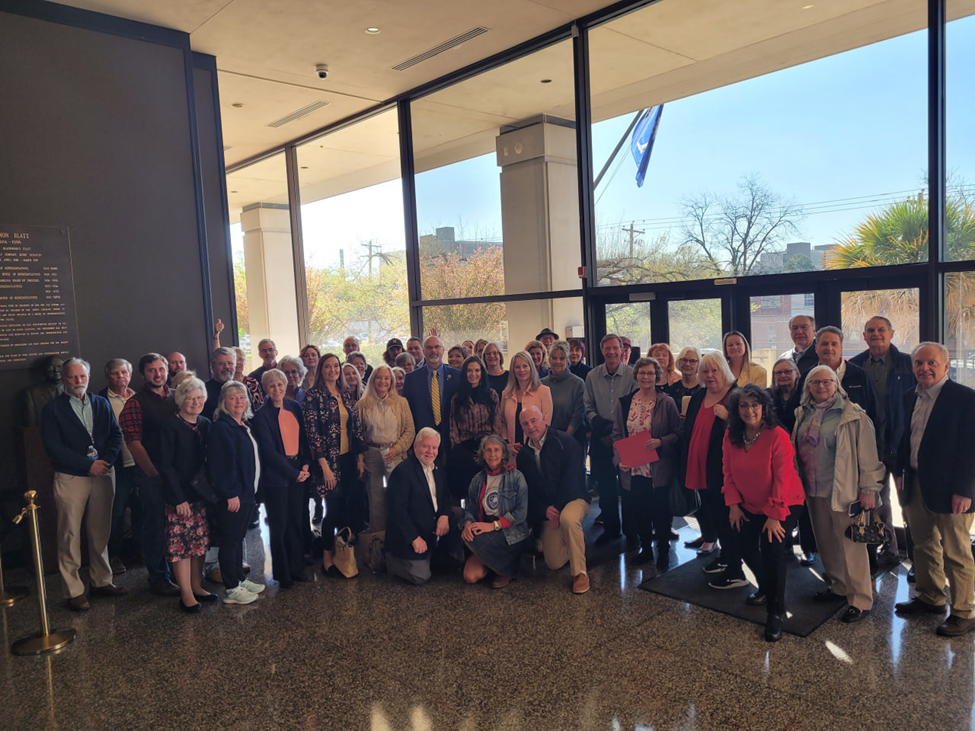
Many thanks to the amazing beautiful people who showed up today for the hearing on H 4935. This bill supports one day of voting on hand marked paper ballots that are hand-counted. Although we didn’t get to speak, it was a victory. Fifty-one people showed up for a hearing in which they knew they might not have a chance to speak and they did so last minute!!!!
They had to open up a room to accomodate the overflow of people who wanted to testify and hear testimony on H 4935 the SAVE Act.
Afterward, most of us went to the offices of the committee to sign their book and let them know we were there and that we had been looking forward to testifying.
Some of us also taped our own testimonies afterwards in the lobby. Below are the ones I received. If you would like your voice to be heard please record a statement on Zoom and send it to scsafeelections@zohomail.com
Remember that for every one person who showed up there are thousands who care about this issue. Many wanted to go, but couldn’t join since it was last minute.
The attendance and passion shown today prove that elections ARE IMPORTANT TO THE PEOPLE and that the PEOPLE WANT TO return to PAPER.
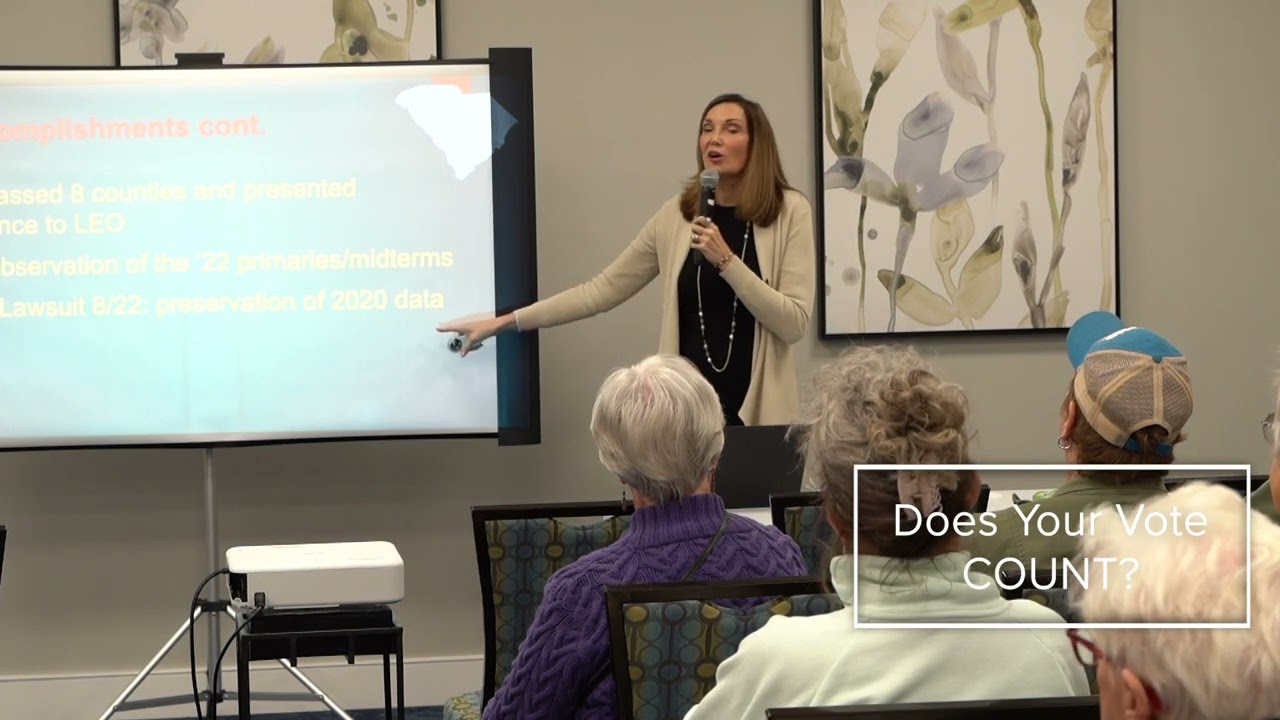
In this presentation, SC Safe Elections’ team leader Laura Scharr discusses progress to date, the implications of (s)elections, and how we can restore trust in the election ecosystem. The gold standard for elections will maximize security, verifiability, transparency, and accessibility. You can help us make the change.
In this same presentation to the SpartanburgCan group Julie Baker discusses the many vulneraiblities of our electronic voting systems in detail and takes questions from the audience.
In this video forensic accountant Laura Downing, cyber expert Julie Baker, data analyst Cryste Carrol and SC Safe Elections founder Laura Scharr discuss the false narratives that are commonly discussed and rebut these fallacies with facts and experience evaulating data across the nation.
Are are voting systems secure even though they aren’t “connecte to the internet?
Cyber security expert Julie Baker talks about the many vulnerabilites in our electronic voting system.
She steps through all the ways risk is embedded in the system.
SC Safe Elections Team Leader Laura Scharr provides the big picture view, why these vulnerabilities need to be addressed and what you can do now to help.
Call or email your legislators today and ask them to make changes that allow more accountability. The SEC wants to fix this by giving themselves more money to the tune of $11M and to hire 50 more employees to audit themselves. BTW, an audit by definition shouldn’t be done by your own organization. That is NOT accountability. Is it time for the Secretary of State–an elected position–to take more responsibility?
In this video, SC Safe Elections talks to forensic accountant Laura Downing and Cybersecurity expert Julie Baker to discuss the audit of the SC Election Commission by the Legislative Audit Council. We summarize the top findings of the report which is a must read and can be found here: https://lac.sc.gov/reports/reports-agency-a-k/sec-2024
How can the people of South Carolina trust their elections when they know that: *Only 58% of the counties complied with the audit. *$5M of election equipment is unaccounted for *Recommendations from the audit done 10 years ago were never implemented *Data was not being shared with ERIC nor were ERIC recommendations for list removals being followed *Post-election hand count audits were not uniform, not done properly and were considered unusable. *Clear Ballot virtual audits also showed error rates that exceeded the allowable machine error rate. *Most concerning, citizens were kept from observing the elections and audits as well as from obtaining valuable election records