Please contact the house constituional subcommittee today regarding supporting H 4935.
Send a letter to the House Constitutional Law subcommittee members and call or email each member below to ask them to support this bill with a hearing:
The lack of security in electronic voting systems has been underscored with the revelations in the Curling vs. Raffensberger case in GA. The Gateway Pundit has been covering this story in detail and the facts are alarming. Here is the info:
Professor Halderman demonstrates by borrowing a pen from the defense attorney and using it to put the election machine in safe mode. He then proceeds to get into the system easily and can alter data.
There is also the ability to hack the system by inserting a “bash bunny” or USB flash drive into the back of the machine and take control within minutes. This could enable the tabulator to be programmed to flip votes every other, every 7th, every xth vote…..
There is a trasure trove of information that makes us question the reliability of these elctronic systems. Read on and continue to follow this case in GA.
After meeting with members of the Charleston legislative delegation (Matt Leber, Joe Busos, Tom Hartnett, Kathy Landing and Jordan Pace) they asked us to draft our ideal legislation or gold standard bill for election. This bill H 4935 the Secure Accurate Verifiable Elections Act (SAVE ACT) was filed last week.
This bill gets rid of all electronics. It calls for 1 day of voting (state holiday) with paper poll books and paper ballots, eliminates early voting and absentee for 65 and over to limit mail in votes. It also establishes strong chain of custody, secure ballots measures as well as videotaping of the counting process. Please contact the house judiciary committee and ask them to schedule a hearing and to vote this out of committee.
(R) Wm. Weston J. Newton, Chairman—Beaufort County (District 120) (R) Wallace H. “Jay” Jordan, Jr., 1st V.C.—- Florence County (District 63) (D) John Richard C. King, 2nd V.C. – York County (District 49) (R) William H. Bailey – Horry County (District 104) (D) Justin T. Bamberg – Bamberg and Orangeburg (District 90) (D) Beth E. Bernstein – Richland County (District 78) (R) Thomas C. “Case” Brittain, Jr. – Horry County, Myrtle Beach (District 107) (R) J. Benjamin “Ben” Connell – Kershaw County (District 52) (R) Jason Elliott – Greenville County (District 22) (R) Thomas Duval “Val” Guest, Jr. – Horry County, Myrtle Beach (District 106) (R) Brandon Guffey – York County, Rock Hill (District 48) (D) Rosalyn D. Henderson-Myers- Spartanburg (District 31) (D) Patricia Moore “Pat” Henegan – Chesterfield, Darlington, Marlboro (Dist. 54) (R) Jeffrey E. “Jeff” Johnson – Horry County (District 58) (R) Matthew W. “Matt” Leber —-Charleston County (District 116) (R) John R. McCravy, III – Greenwood & Laurens (District 13) (R) Cody T. Mitchell – Darlington County (District 65) (R) Travis A. Moore – Spartanburg (District 33) (R) Robby Robbins – Colleton & Dorchester (District 97) (D) Seth Rose – Richland County (District 72) (R) Carla Schuessler – Horry County, Myrtle Beach (District 61)
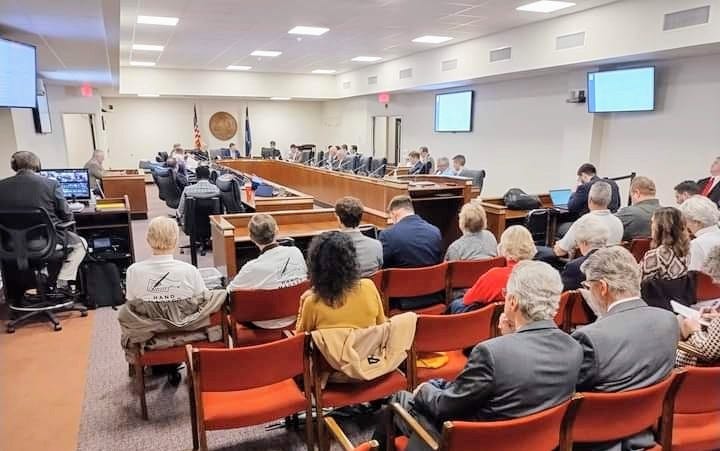
All of your hard work resulted in us getting a hearing for the election bills filed by Rob Harris H4259, H4260 and H4261. We went to the Blatt building last Thursday and it was a crowded agenda of multiple election bills. We were still able to get our speakers to testify on 2 of the 3 above bills.
This bill calls for a hand count audit of at least 5 races within 3 precincts of each county and should include one statewide office or question; one federal office; and one countywide or less than countywide office or question
It also allows a county or county chair of a political party to call for an audit up to 22 months after an election (hand count or forensic).
H 4260 eliminates early voting, calls for a return to paper poll books and gives full observation rights to every citizen to observe all phases of the election process and establishes chain of custody documentation to be recorded for all components of the election systems at all times.
It also removes the 65 and older provision for absentee voting thereby reducing the amount of mail in voting.
Most importantly, it establishes a pilot program for 2024 for at least 3 counties to cast votes on hand-marked paper ballots counted by hand. THE PEOPLE WANT PAPER!
The videos of these are below and the speakers who advocated for these bills were nothing short of excellent. These are a must watch!!!! Special thanks to Lea and Julie for taking the time and driving to Columbia to make this happen!
So far these haven’t come out of subcommittee. (The next step would be for them to go to the House Judiciary Committee). In order to track progress on thewse bills download the SC Legislature app to get alerts on the bills.
Would this be allowed in corporate America? No wonder we don’t trust elections
The Legislative Audit council was tasked with auditing the SC Election Commission and the report that was released this month is eye-opening. From their website: “The South Carolina Legislative Audit Council conducts independent, objective performance audits of state agencies and programs, as requested by the General Assembly and mandated by law. The purpose of this oversight role is to provide information which will assist the General Assembly and the public in determining whether state agencies are efficiently, effectively, and lawfully managing public resources, and whether agency programs are meeting their intended objectives. “
The report that was released this month is eye-opening. Forensic auditor Laura Downing read the report and released this summary statement and sent it to the governor. She sent a bit lengthier summary to the heads of the senate and house. See the document below:
This report underscores the complexity of our election processes as well as the lack of transparency. There are many areas of concern as well as the fact that recommendations they gave 10 years ago when they last audited this agency were not followed.
We encourage you to read this as the summary doesn’t do it justice and the report is quite comprehensive as well as concerning. My favorite part is about teh Richland county whiteboard that listed all the passwords for the machines and said “don’t give these out.” You can’t make this up.
Here is the link to the full report: https://lac.sc.gov/sites/lac/files/Documents/Legislative%20Audit%20Council/Reports/A-K/SEC_2024.pdf
What a great day and a powerful moment. We will never forget the feeling of passion and patriotism in the state house on January 9th. It was a great vibe and so wonderful seeing all the beautiful smiling faces of people who care about their country and their vote in the same room. Much thanks to all of the speakers. They did a great job. The weather held off until the mid afternoon so we were able to start around 9:45 and end at 11ish. So many of you met with your legislators afterwards —We are sure they felt the blitz. In fact, the York group even waited by the entrance to the state house from the garage to educate the legislators as they entered the building. 😊
Despite the weather, school closures and storm warnings, patriots showed up! Over half of our counties were represented and we had over 150 people there by our guesstimate. We had 250ish confirmed prior to the weather so if the weather had cooperated it would have been closer to 300. We want to acknowledge all of you who took the time to be there, took off work, braved the storm, made signs, listened to the speakers and then talked to your legislators. This is how we affect change. Numbers matter and we showed how this issue is broad and deep in SC. Kudos and heartfelt thanks and appreciation to all of you.
God had us there at the time for a reason and it yielded more blessings.
The results—
S406 for now is essentially killed. You did that!!! No uploading of early voting results before the polls close.
Bills H. 4259, H4260, and H4261 are going to be heard next week in the House Judiciary committee. You did that too!
All of you made this happen with your letters, calls, signs (which were great by the way) presence, prayer and persistence. You should be very proud of yourself. We the people can make a difference.
With Appreciation,
The SCSE Team
Here is the link for those of you who couldn’t make it.
In this video poll watcher Cathy Mogy, discusses here experience in Florence County where she witnesses some she believed were appalling actions by the poll workers. I tshook her faith in the entire process
It is important for people to work the polls so that they can better understand the process and also document any concerns. If there are questions they can call the board of elections in their county and if they suspect any serious issues they can call SLED. The South Carolina Law Enforcement Division’s Election Fraud Hotline at (833) 4SC-VOTE / (833) 472-8683. Once your supporting documentation has been received by email or mail and reviewed by staff you can expect follow-up correspondence from SLED.
We will have a hand count demo taking place in the lobby; and if it rains, we will also be congregating there as well. We have about 200 who have committed to come. It is extremely important that we show up in numbers!!!! This is what gets the attention of our legislators. We would like to get every county represented. Contact notdamama@protonmail.com if you plan on attending.
Many of us, regardless of party affiliation, believed that something wasn’t quite right about the 2020 election. Unfortunately, the 2022 elections and latest 2023 elections underscored continued issues with the electronic voting systems. Just a few examples are the ballots that were unable to be read in AZ, results that were unable to be reconciled in Texas and GA, and PA vote “flipping” in races. This persistent pattern has resulted in voters as well as candidates losing trust in the system.
Our legislators and election officials tell us to prove that there is fraud, but it is not our job to prove fraud; it is their job to prove there isn’t. The potential for fraud is very real. The inherent risks of computerized or electronic systems are numerous, and you only need one to corrupt the results of an election.
We have found plenty of problems in our SC voting system. Canvassing results from the 2020 election showed that in South Carolina we had dead people voting, people voting who had moved away from the state years ago, and people voting whose address is a commercial address—none of these are legitimate votes and they cancel out our legitimate votes. In fact, in Charleston, there were enough bad data points (phantom voters) to indicate that at least 3 races could have been flipped due to the data we found. Even if the data didn’t change the results of an election, how many bad votes are we willing to tolerate?
Computers are supposed to be accurate and efficient and yet we know that accuracy of our elections continues to come into question. Our state law (Section 7-13-1340 (C ) states that if the system is not accurate then it should no longer be used. Furthermore, our state constitution (Article II Section 1) mandates that we not count ballots in secret and yet we have a black box system that does just that. If machines are so efficient, why are certain areas in our country counting votes for weeks?
Poll observation in our ‘22 elections showed election laws not being followed as well as computers that were not secure and computer “glitches” that flipped votes. There were also candidates missing from the ballots. You can read our report here. https://www.scsafeelections.org/poll-observer-results/
No system should be tolerated if the public doesn’t trust it. We need a transparent, accurate method that people can feel confident about. The press and elected officials lambast hand-marked, hand-counted ballots, but they haven’t truly explored this method nor has it been done in decades in this state. We are currently conducting testing of this method and also writing a whitepaper with grassroots leaders in other states. We believe we have a great method that can be done in a timely, efficient manner and would request the opportunity to test it in pilot programs in a few precincts and counties.
It took the Netherlands 5 months to move to paper ballots. It took Argentina 4 months to make the transition to paper ballots. They had an election with 30 million people and they finished counting in one day. It can be done. Instead of thinking of all the reasons counting hand-marked ballots won’t work to justify a $51M purchase of a system people don’t trust, let’s work on how it can be done.
In the meantime, let’s move to greater transparency for our current system by allowing the public free access to voter rolls, security logs, and cast vote records, among other things. Let’s work together to make our SC elections the model for the nation. Let’s get rid of ERIC and manage our rolls internally. Let’s engage citizens in a discussion of how we can innovate and reengineer this process rather than uniformly denying anything could possibly be wrong and disallowing access to public records that other states provide to their citizens.
The issues we have witnessed across our nation over the past few years are endemic. If there are issues in other states, even with other machine manufacturers, there will be issues in South Carolina. These systems have very similar architecture. Denying the reality of the risks and vulnerabilities is naïve and doesn’t solve anything.
Let’s stand together for free, safe elections that are secure, transparent and verifiable. While Act 150 was a first step, we need further work to truly secure our elections. We ask you, our state representatives, senators, and governor to work for us and help us feel more confident about our vote. Properly run elections with transparent counting of all of the votes are the key to a strong republic. Please allow hearings on election integrity bills H.4259, H.4260, H.4261 and H.3162 and let’s bring these bills out of committee for a floor vote.
Furthermore, let’s ensure that bad election legislation is not passed, like ranked choice voting and bill S406, which calls for uploading election results early. Incremental changes such as these make our systems more vulnerable to potential bad actors. Let’s protect the sanctity of our vote in South Carolina and restore confidence in our state’s elections. We the people are counting on you to do the right thing.
Did you know that SC voters don’t have a way to verify that their vote counted?
Your vote is not counted in public, it is counted in secret.
RESOLVED, The Republican National Committee calls for a necessary “return to excellence” or in other words, a return to the simple and proven methods of precinct, ward or geographically-defined localized voting with auditable balloting procedures using paper ballots, in fair, reasonable limited time periods, using proper identification to strengthen voter confidence and to ensure that American election procedures can be a fair and open process for all to participate
Problem: Paper ballots should not be coded as the voter cannot verify. Cast Vote records which are valuable audit tools aren’t currently accessible to the public.
Solution: Bill 4261 ensures that all records such as voter rolls, Cast Vote Records (CVRs), activity and security logs, ballot reconciliation, chain of custody, incident reports and other key audit records should be available for free to the public so that they have increased confidence in the veracity of their vote by analyzing results independently. This ensures accountability of the SEC SC State Election Commission. After all, this is the people’s vote and they paid for these machines and the salaries for the agency employees. We should have access to these crucial reports to ensure that we optimize faith and trust in our elections.