Last August SC Safe Elections filed a claim against 8 counties and the SC State Election commission (SEC) to gain access to Cast Vote Record (CVR) reports. Our new machines were purchased so that there would be a “paper audit trail.” The CVR is meant to do just that. It looks at the votes as they are being tabulated over time and thus it provides a pattern of data that enables analysts to confirm the vote tallies and look for any anomalies.
Jeff O’Donnell along with other analysts has been working on analyzing these reports all across the country for over a year and he recently issued a report summarizing his results. His conclusions are alarming. See his executive summary here:
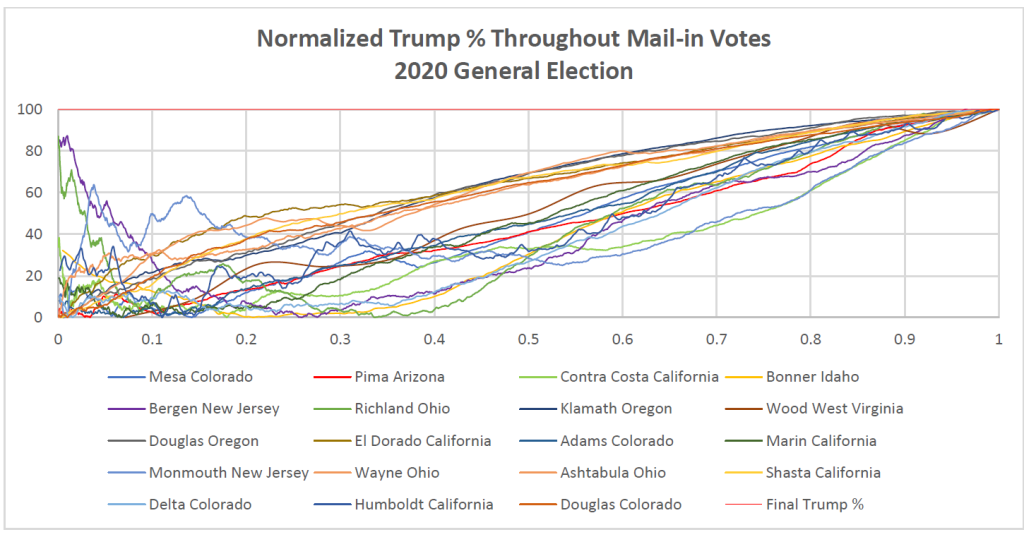
There appears to be an initial front-end load of the ballots where candidate percentages varied vastly from the subsequent lots.
The report’s conclusion states: “REVIEW AND CONCLUSIONS The Cast Vote Record produced by the various election systems’ software is a tool for auditing any election. It is the digital equivalent of a sequential list of an election’s ballots and their individual selections. Its purpose is to preserve each voting transaction so that the election outcome can be verified. Being in digital format offers the advantage of rapid computerized analysis. In a fair and legitimate election, the analysis of randomized mail-in voting transactions would follow proven and reliable mathematical patterns. In the 2020 General Election the patterns of voting transactions do not. Cast Vote Records from across the United States show mathematically impossible voting patterns, that shockingly demonstrate a predictive and intentionally manufactured similarity. Any fair-minded review of the election data can only leave one to conclude that the United States of America was the victim of a coordinated, multi-state, conspiracy to defraud the 2020 General Election.”
This is a must read and further underscores why our team is trying to gain access to this report in South Carolina via Freedom of Information Requests (FOIA). The excuses for why we can’t have access seem trivial compared to the value of enhancing transparency and trust in the election process.
In short, humans don’t vote in those patterns. It violates the law of large numbers. These results are statistically impossible.
Our Governor and our Attorney General should do the right thing and give the people access to this very essential report.
Please help support us by giving to our givesendgo fund to help us fight this battle for our state.
Well…well…well…another “election bill” being considered in the House. Last year it was H. 4919, a bill signed into law that institutionalized early voting, 14 days of early voting, in the state of South Carolina.
This year it’s S. 406 – a bill that would provide that the tabulation results from early voting be posted to the election management system BEFORE the polls open on Election Day. PLUS, under this bill, the counties would be required to report election results – not 24 hours after completing the canvassing and counting of ballots, as the law stands now – but the counties would be required to report election results continuously throughout Election Day, as prescribed by the State Election Commission (SEC).
ASK YOURSELF: Why would it be important for some people to be able to see the early voting results as they are coming into the state?
Let’s do a deeper dive…
TITLE: TO Amend the South Carolina Code of Laws…To Provide That Ballots Cast During The Early Voting Period May Begin To Be Tabulated At The Same Time As Absentee Ballots
WHAT THIS BILL DOES:
Section 1. It allows for the results from the early voting period to be tabulated and uploaded (via flash drives) into the Election Management System (the County Board of Elections Computer) at the same time as the absentee ballots start to be counted, which is 7 am on Election Day. The bill also states that the results from absentee ballots and early voting ballots would not be made available to the public until the polls close. So, presumably those charged with executing our election process WOULD have access to these results…before Election Day gets underway. Why would they want that?
Section 2. This part of the bill would amend the SC Code to say that the unofficial election results by managers of county board of elections must report – not at the completion of the canvassing and counting of ballots, which is how the law reads now – but “CONTINUOUSLY AND WITHOUT UNDUE DELAY” to the State Election Commission, as prescribed by the SEC. (which was amended today in the Constitutional Law Subcommittee to “as prescribed by the Executive Director of the SEC, in other words, Howard Knapp.”)
Why would the SEC want to keep tabs on the way the votes were coming into the state? Why does the SEC have the authority to determine how the reporting should come in? How will this reporting come in since “the machines are not connected to the Internet.” (sic)
Section 3. This section adds that any audits that are performed after the election must be conducted publicly. (NOTE: Audits are only conducted by methods “deemed appropriate by the Executive Director.”)
WHY THIS BILL?
According to testimony given today in the House Subcommittee on Constitutional Law by a “Miss T,” this bill is important because it would alleviate the extreme pressure on the election workers. Hmmmm….how long does it take to insert a flash drive into the system to upload the results? Are we really saving time here?
Could this be done later in the day? For perspective, to transfer 1Gbyte @ 10M BPS (e.g. Ethernet) it takes about 15 minutes. They will still need to do this so no time saved it would just happen much earlier.
Is there another reason why some people would want this information to be uploaded PRIOR to the opening of Election Day?
Who would be able to see this information?
Why would they want it?
What would they be able to do with this information once they have it?
BOTTOM-LINE: What is the REAL motivation of this bill?
As a friend of mine remarked to me, “What this bill does, is it gives the state, county, SCYTL, SEC, DHS and CISA and God only knows who else that can hack into the system, early information that could potentially enable a bad actor to have that information to be able to change election outcomes. It gives them a heads up.”
If that is the case, if the real reason is to enable state actors in charge of our elections the ability to influence, or even change, the outcome of an election, I can only say that the effect of this bill is to potentially “codify the steal.” And, that’s not good.
Anything that could possibly subvert the will of The People, or impinge on our State Constitution’s mandate that votes are to be cast in secret (are they really being cast in secret if people behind the scenes are monitoring the trends?) and counted publicly (not early or behind the scenes) should be defeated.
CALL TO ACTION: Please call your legislators to tell them to NOT PASS THIS BILL. It makes no sense.
At SC Safe Elections we value transparent and accurate elections where there is accountability. This is why we felt compelled to sue 8 counties as well as the SC State Elections Commission (SEC) to gain access to a valuable audit tool called a Cast Vote Record also known as a CVR. These records are unique is that they look at the progression of votes over time as opposed to the total count which is one snapshot in time. The sequence of the vote count would enable us to see how the vote changes over time to look for anomalies.
Note also that our votes are currently being counted in secret which is against our SC Constitution Article II Section 1 which states that our votes shall be cast in secret but not counted in secret. How can we know how our votes are being counted if we don’t have access to a report that 28 states and the District of Columbia have access to and that has been around since the mid-2000s. And why are our election officials claiming they have no knowledge of this tool which is used in several election offices across the country. In fact, CVRs (Cast Vote Records) were meant to be for the public as well as election officials per the NIST manual on CVRs. Furthermore, our state spent $51M on these new machines expressly for the benefit of a “paper audit trail.” Why have the trail if you don’t use it or make it available to the public. How does that inspire confidence in our elections?
Unfortunately, the defendants are playing coy and using lawfare to not answer discovery questions that should be straightforward. For example, see Aiken’s responses here.
This is pretty typical of what we received from the Election Commission as well as the other counties:
The county claims they don’t know what SEC stands for and if it does mean State Election Commission they don’t know what information communication or materials may have been shared between the SEC and Clear Ballot; nor do they know what the term define means….
They don’t know all the entities, consultants, contractors, that provide their election related itesm or service nor the tasks that they provide?
They don’t seem to want to answer the question of what PII or Personally identifiable information is.
They don’t know what a voted ballot, ballot image, or cast vote record are?
They don’t know what reports they are capable of printing nor the software on their system.
Literally, every answer starts with the words, “defendant does not know.”
It goes on and on……but this certainly don’t seem to want to answer these questions in good faith. They appear to be refusing to answer any questions thoroughly or at all. Does this enhance your trust in our election system or the people who are running it?
Are you disgusted yet? Will you tolerate this from your government agencies? Unfortunately we are seeing this trend of disrespect for people obtaining facts and information via information requests across the state as well as the nation.
This can’t be allowed to stand. Transparency is the cornerstone of a strong republic.
Please help support this lawsuit and our effort for enhanced transparency by spreading the word and contributing to our givesendgo campaign.
Below is a refresh of the Berkeley February meeting covered.
The follow-up meeting is being held on Thursday, May 4th , 2023 at 10:30am to address the issues brought up at the February 23rd, 2023 Berkeley County Board of Elections meeting.
Berkeley February meeting–drama, drama, drama
The February meeting was to address the fifty pages of compiled data gathered from poll workers from the November 2022 elections submitted by the Berkeley County Republican Party.
Upon walking into the door, it was obvious that it was packed with at least a hundred people and there was already an air of tension. Quite a stark contrast when compared to the previous meeting that was held on January 10th, 2023 at 10:30am, when only ten people were there as the board addressed the 200 votes that were being challenged from the 2020 general election. The meeting began with the Director, Rosie Brown, reading a Director’s Report which had been previously written and seemed to be preemptively laying the groundwork for the upcoming dismissal of the issues being presented. At least there was one thing that was consistent between the two meetings in January and February, the board’s tactics: dismiss and deflect responsibility to the state. After the pre-approved report was read, the board then briefly addressed a few, like two or three, of all the items presented. This involved either an explanation to justify the issue or absolving themselves of the responsibility of the issue. It seems that all the problems are due to the State Election Commission and the elected local delegation. In no way does any of the blame fall on the Berkeley County Board of Elections or the Director. Subsequent to this short address, were the public comments.
Despite the fact that fifty pages had been presented and such a small percentage of the issues discussed, the Chairman of the Berkeley County Republican Party, whom submitted the issues, was only given five minutes to speak. Very shortly after she began to read some of the issues, the crowd started shouting that her time was over. Per Robert’s Rules of Order, which is supposedly how meetings are to be run unless other rules have been established, the gentleman who was to comment behind her granted her four of his five minutes of public comments, so she continued. Well the crowd, who was apparently running the meeting, would not acknowledge this and began yelling obscenities like “shut up” and “sit down”. The board was unable to regain order and explain to the crowd the rules of meetings so the Chairman did sit down as she was unable to be heard over the shouting from the crowd.
With the next speaker, the crowd, who was obviously in charge of running the meeting during the public comments, all had their phones out and were timing the individuals speaking. It didn’t matter if they were interrupted or if the board was responding to the questions, it was all considered part of the person’s time and the crowd would promptly yell for them to sit down when they felt their time was up. This led to phones throughout the room ringing as alarms went off and continued despite one of the board members repeatedly asking for phones to be turned off. In one of the comments, the ringing was so loud, it sounded like a car alarm, and it seemed the person was unable to turn it off so it completely prevented this lady from being able to be heard during her timed five minutes. She was explaining that she was told, at the last meeting she had attended in January, by one of the board members, Don Rose, that she and a group of three other women should stop worrying their pretty little heads about election integrity and that they should instead go out and get boyfriends.
In one instant, the person issuing a comment regarding the picture of the inmates physically handling the ballots during the audit had not reached the end of her time but said something the crowd didn’t like so she was immediately cut off and could not proceed over the roar from the crowd.
Throughout all of this, the Chairman of the Board of Elections, Don Saturday, only banged his gavel twice and told the audience to act in a professional manner. The board did not seem bothered by the way citizens exercising their right to public comment were being treated or that their time was being infringed upon by the loud, ruling mob. This continued on through all the public comments highlighting different election issues, the crowd’s noise making it very hard to hear the facts. In one instant, the lady was simply asking why the meetings are held during the day when people are at work and not livestreamed for everyone to see. A very valid question and definitely important when it comes to transparency which is vital in election matters. Magically, the stopwatches were not used and the shouting stopped when it seemed someone with their view point stood up to speak. Not surprising, the side there to discuss election issues did not time them or interrupt them or tell them to sit down.
At the end of the board meeting, the board was asked about returning to paper ballots to which one of the board members, Pam Lamb, responded that she knew Berkeley County residents did not want paper ballots or to get rid of the machines because she had seen it on the national news.
What are the next steps and what can you do?
If you are a Berkeley County registered voter and you want your voice to be heard peacefully, if you have concerns about elections, if you are interested in paper ballots being counted at the precinct level or if you have any other thoughts, concerns, or comments relating to elections:
SHOW UP. The next meeting will be Thursday, May 4th, 2023 at 10:30am in the building where taxes are paid, address: 1003 US-52 Moncks Corner, SC 29461.
Ask for and encourage the local media to be there. They care about election irregularities, right?
Contact and inform your local elected officials as they should also be present because they want to ensure their races are being conducted fairly and transparently, right?
Insist that there needs to be some form of law enforcement present to ensure there is order since the board is unable to control the crowd. People should not be intimidated or afraid to speak and an appropriate environment, free from violence, yelling and obscenities, needs to be provided for all Berkeley County Citizens.
Remember all the power should be with the people but our voices need to be properly heard.
Bill H. 3695 was introduced by Brandon Newton, the State Representative who successfully shut down a closed primary bill debate in last year’s session. H. 3695 really is about Voter Registration and Party “Affiliation,” not closed primaries. There is only ONE PASSAGE relating to closed primaries, which states, “In no event may an elector registered as a member of a certified political party vote in the partisan primary election or advisory referendum of another certified political party with which that elector is not registered.” So a Democrat couldn’t vote in a Republican primary and vice versa.
H. 3695 has the highest chances of passage of all the closed primary bills. You can tell by the number of State Reps who have jumped on the bandwagon to become sponsors. A week ago, the Chairman of the Judiciary Committee (where the bill currently resides), Wes Newton, added his name as sponsor. This bill is showing lots of activity. So, what is in this bill? And how is it different from the “Closed Primary” bills?
H. 3695 states that an elector must be registered as a member of a certified political party or unaffiliated within 45 days of a “partisan primary.” A party affiliation can be changed, but only in writing and on a form approved by the SEC. The voter application form must be changed to allow for a party preference to be noted.
CONCERNS: Under this bill, there is still a way for an unaffiliated voter to vote in a party primary. So although we exclude parties from crossing over to vote in their opposing party primary, unaffiliated voters would still be able to vote; so technically this is not a clean closed primary bill.
The second part of the bill deals with candidate qualifications. A new section will be added to the SC Code which states that the “State Executive Committee” of a certified party may establish party rules to require all prospective candidates to be registered as “affiliated” with that political party. Should the State Executive Committee have the authority to do this or should it be at the state convention? Is it appropriate for a state statute to mandate how a candidate is vetted or approved by the party? Who should be able to make the “party rules?” The delegates at the State Convention, the State Executive Committee, Or? What does it mean to be “registered as affiliated with that political party?” Wouldn’t being registered with a certified political party be enough?
Will this provision result in qualified candidates being excluded from the ballot because they don’t meet qualifications of being “affiliated” spelled out in new rules? Look at the recent “loyalty oaths,” which prohibit House members from endorsing or supporting any candidate challenging a GOP incumbent. As stated in this article, the loyalty oath is really code for an “incumbent protection racket.” Those who won’t sign are barred from attendance at the Republican Caucus, where most of the legislative deliberations take place. To be barred is to be deprived of access, hence power, the currency of politics.
Could this provision empower party leaders to enact party rules to exclude those candidates of whom the party establishment disapproves? Yep. Is that the main purpose of this legislation? Maybe. Will President Donald Trump be prohibited from being placed on the Republican ballot if he refuses to sign a GOP loyalty oath? Possibly. Are similar bills being introduced nationally? Will this provision have the effect of excluding Freedom Caucus members or America First candidates? Is there a difference between registering with the party and being “affiliated” with it? If you register, you are responsible for your relationship with the party. If you are “affiliated,” do you need to be approved by the party to be associated with it? Are there party caveats? Will there be more requirements for entry into the party?
Finally, the bill states that the SEC must establish a voter education program concerning the provisions contained in this legislation. While a right idea, this provision is weaker than passages in the previous bills which require all electors to be contacted and informed of this new change to our voting laws…by a certain date.
In summary, where do we stand? It seems as if H. 3695 will be the bill brought to the House floor for passage. So here are some recommendations for how to make the bill stronger:
Informing the public of the change: Section 4. The State Election Commission must establish a voter education program concerning the provisions contained in this legislation. AMEND AND ADD the following language from H. 3685 Section 1C. “Prior to January 2, 2024, the entity charged by law with registering qualified electors shall contact the qualified electors of that county, by whatever method it determines to be appropriate, informing them of partisan primary voting procedures…
Changing voter registration party status – put in some time limits. DO NOT allow someone to change their party status right before a primary election and then back again before the general election: See Section 1C – It should be stated that changes can be made by affidavit or written authorization of the elector and that an elector is prohibited from making any changes to their registration 1 – 2 YEARS from the time of the change. Changes must be made 45 days prior to the primary election.
Allow certified political parties the ability to decide for themselves whether or not they want to include unaffiliated voters. Done at the State Convention (as stated in the previous bills) not by State Executive Committee
Candidates: change the vetting process as follows: Let the party decide how to handle candidate qualifications…or better yet eliminate Section 3 B from the bill and remove any mention of candidate qualifications. This would make the bill “cleaner” by establishing rules for the qualified electors not the candidates.
With these changes, the bill might be worth passing.
Several pieces of legislation are currently pending in the House Judiciary Committee relating to Closing the Primaries. On the surface, it would seem that closing our political primaries would enhance the safety and security of our elections. But would it? Let’s examine the bills: (If you don’t want to read through the details of the bills, go to the bottom of this blog post and read SUMMARY.)
A couple of terms you need to know: Elector – someone who is eligible to vote in the state of South Carolina Unaffiliated voters – SC electors who are not affiliated with any recognized “certified political party”
Certified political party – Although there are hundreds of political parties in the USA, only certain parties are “certified” to be able to have their candidate names on election ballots. South Carolina recognizes 10 political parties: the Alliance, Constitution, Democratic, Green, Independence, Labor, Libertarian, Republican, United Citizens, and Working Families parties.
A candidate may choose to have another label other than a certified party next to his/her name on the ballot. This is called a “political party designation.” South Carolina does not allow candidates to use political party designations. What that means is if a candidate is part of a newly-minted party, such as the “Constitutional Patriot Party” (made up) or the “US Beijing Party,” he or she would not be able to appear on a SC ballot. For example, it was just reported that Governor Kemp of Georgia is creating a “new GOP Party” called the “Cherokee County Republican Coalition” which would have to be “certified” if it were in the state of South Carolina according to this law in order for any of its members to appear on the ballot. Same thing if President Donald Trump tried to start his own party. Something to keep in mind.
The Bills: An Analysis
H. 3161: IN GENERAL: A SC citizen would not be allowed to vote in any “partisan” primary except that person has to register to be affiliated with that party, UNLESS the certified political party decides to accept unaffiliated voters. (There is no direction as to how the political party would arrive at such a decision. It’s left up to the party. If the party deems that unaffiliated electors CAN vote in the party primary, the party would have 60 – 180 days to notify the State Election Commission (SEC).) The SEC is charged with working with the counties to come up with a form and process for registering electors by party. Such form would be open to public inspection (except for social security numbers). When voting in the primary, all electors are required to sign an affidavit affirming membership in that party conducting the primary.
CONCERNS: Electors who have not registered with a political party would be unable to vote in that primary as they would be considered “unaffiliated voters.” This has not occurred before in recent years. For this “Close our Primaries” effort to be successful, there needs to be a massive awareness campaign waged so that South Carolinians who want to vote know they have to sign up with a single political party. There is a risk that thousands of South Carolinians will become disenfranchised voters in the 2024 Presidential election, because they are uninformed about the changes. What you could see in 2024 is many South Carolinians wanting to vote for Donald Trump in the Republican primary, but being unable to do so because they never registered with the Republican Party. Or vote for Robert Kennedy Jr. but can’t because they are not registered as a Democrat. (This bill tries to ameliorate this issue by allowing electors to register for a party at all primary elections before June 1, 2024, by having an elector submit an oath before an election official overseeing the election.)
Registering and being affiliated with the party: The state convention of a political party may add rules about qualifications for membership in the party, as well as eligibility for voting in the primary election. While it is understandable that the party would want to have a mechanism for vetting prospective electors, i.e., the Republicans don’t want closet Democrats signing up for the party and vice versa), we’ve also seen some recent party rules that have potentially disallowed whole groups of people from becoming affiliated with the party. This could adversely affect the American First movement, as well as others.
No provision for how the certified political parties would determine whether or not they would accept unaffiliated voters. Party State Convention? State Executive Committee?
Danger that incorrect records could lead to disenfranchised voters. We know that the SEC has had many incorrect records relating to people’s voting records in past primaries. What makes us think that they will get an individual’s voting preference correct? If there is a mistake in the record, that elector could be prevented from voting in a primary. There is no restriction on changing registered party status. That means, for example, I could register as a Democrat for the primary, but change my party affiliation to Republican for the general election.
H. 3472 This bill is almost identical to H. 3161 except for the following differences:
If an unaffiliated voter votes in a certified party primary, such voter automatically becomes a member of that party for two years. This addresses the time limit question.
This bill also sets a time limit on when electors need to be made aware of this new requirement to register with a certified political party in order to vote in that party’s primary. Electors need to be notified before January 1, 2024.
H. 3685 This bill is also similar to the previous bills with some notable exceptions: It is the state executive committee of a certified political party who decides whether or not unaffiliated voters may vote in the primary election. Otherwise, in the previous bills, the state convention decides the qualifications for membership into the party and voting in the primary elections, which seems more democratic.
This bill addresses candidate party qualifications and states that a political party has the ability to require all persons wanting to appear on that party’s ballot to be registered as “affiliated” with that political party. It also states that a party may not refuse to certify a candidate based on party affiliation who is registered as affiliated at the time of filing. This seems like a protection against party actions such as the time SCGOP censured and banned Greenville County GOP Chair Jeff Davis from attending SC State GOP meetings because while he was a “registered Republican,” the GOP State Executive Committee, led by State Party Chair Drew McKissick, declared him “unaffiliated” or not eligible to participate, based on some “charges.” Read the article and decide. Finally, there is no time restriction for changing party registration.
SUMMARY
In summary, it appears that closing the primaries in the state would be a step forward in our quest for safe and secure elections, by eliminating our election process of potential outside interference. We want to ensure all of our elections reflect the will of the people. In this case, the success of this effort will hinge on the following:
A massive information campaign to inform the electors about this change and to prevent them from being disenfranchised from voting through an “unaffiliated voter status” by default.
A time limit placed on how soon an elector can change parties after registering with one certified party. Attempts to “game the system” should be thwarted, i.e., changing party affiliations often needs to be not discouraged, but prohibited.
The SEC must be held accountable for keeping accurate voter files, with respect to electors registering with certified political parties Any decisions – whether it be to include unaffiliated voters in a certified party election or to put candidates on the partisan ballot – should be made by the people within the party, and not at the centralized executive level. We want to ensure that all SC electors who want to participate in primaries are able to do so and all candidates be given a fair opportunity to be listed on election ballots.
Thank you to all the SC legislators trying to improve our election system.
In this video, Kershaw county resident Aleisa McKim discusses her experience checking her voter roll history prior to her county convention for reorganization. Her story will shock you.
SC is now one of the first primary states in the nation. Let’s clean up our act and close our primaries
Last summer a group from SC Safe Elections met with some SC legislators to talk about election reform. We asked them this question: “What is THE MOST IMPORTANT election reform measure you’d like to see passed? TheirAnswer: “Close our primaries.”
Why is this so important? Because you can use open primaries to throw a primary election. Let me explain…
What are “open” versus “closed” primaries? Right now, South Carolina has open primaries. An open primary is any primary election where a voter does not have to declare a specific party affiliation in order to vote in the primary. That means Democrats can vote in a Republican primary and Republicans can vote in a Democratic primary. A closed primary is one in which a voter can only vote in the primary with which he or she is registered/affiliated.
The problem with open primaries is that they can lead to dilution of the people’s vote and possible manipulation of outcome. Let me break that down. For example, let’s say you are a registered Democrat. Under an open primary system, you and your friends can go out to vote against the most viable Republican candidate in an effort to throw the primary election to the less viable candidate. The same thing would hold for Republicans. Under an open primary system, as a registered Republican, you and your friends could go out to vote for the weakest Democratic candidate in order to increase the chances of this candidate winning the primary, thus improving the chances of the Republican candidate winning in the general election. This is particularly impactful when primary turnout is low–last year’s turnout was less than 20% statewide.
The potential for abuse is even more dire when you think of how political organizations could use the open primary system to their advantage. Here’s an example: let’s say there is a Republican candidate who spoke out in favor of a bill banning abortion in the state and this same legislator is now running in a contested primary. Planned Parenthood then mounts a campaign and mobilizes its members to get out the vote and to cast their vote against this incumbent Republican legislator in an effort to defeat him in the primary. These kinds of efforts thwart the will of the people. No one – no person or political organization – has the right to employ a strategy to throw a primary election. Such efforts disenfranchise state voters.
We must close our primaries.
Our legislators know this. Last year there was an effort made to do this by offering an amendment to the omnibus “election integrity bill” that ultimately passed both houses. Unfortunately, just as this issue seemed to be gaining momentum on the House floor, the amendment was tabled after some impassioned debate and ended with an eloquent floor speech, given by Representative Brandon Newton, who shut the conversation down.
It has come to our attention that many of the voters are checking their voter history and finding inaccuracies. For example, their records states that they voted absentee when they always vote on election day in person. Or it shows a missing vote in a primary although they never missed an election in decades. This is important because the Republican party now requires that anyone who wants to run for a state delegate position must have voted in 2 of the last 3 primaries.
Post reorg, precinct delegates around the state who want to run for state delegate positions are asking their county board of registration and elections for their voting history and finding massive inaccuracies. This is disturbing since our voter rolls should be accurate. Garbage in Garbage out. If our voter rolls are inaccurate, what else is inaccurate?
In order to better analyze the extent of the problem we are asking that people fill out the following form if they find any inaccuracies of any kind. We will follow up for more information so that we can make our legislators, election commission and other state leaders aware of the issue so that it can be properly addressed.
Here is the link to the form:
Here is the link if the form above doesn’t work: https://form.jotform.com/231017986413052
In this clip from a recent Conservative Daily podcast computer experts discuss how easy it is to hack into a voting system; Mark Cook shows how it can be done in minutes with a simple flash drive. Scary stuff. Send to all those legislators who still think voting machines are a must.
Remember these cyber guys want to computerize everything but they insist the only way we can trust our vote is to go to a secure paper ballot system that is hand counted.